www.Lookscar.blogspot.com

The Volkswagen Jetta’s long-awaited changeover from the current inline-five-cylinder engine to a turbo four will happen in 2013 for the 2014 model year, the company’s U.S. product czar Rainer Michel told us this week. Soon after, Michel says, the engine will land in a 2014.5 model-year Passat. This confirms the timing we heard earlier from a different—and has-to-stay-nameless—source.

www.Lookscar.blogspot.com

The BMW 328i Luxury's logbook had finally cooled down after a disappointing trip to the local road course when something else happened: the weather heated up. Between surviving one choice mishap and dealing with sweltering temperatures, our BMW has had a rough month.

www.Lookscar.blogspot.com

Vorsteiner has created a new aero package for the already gorgeous 458. This includes a front spoiler, side skirts and a revised rear diffuser. This is combined with specialised 21 inch rims. All parts are made out of carbon fibre.

www.Lookscar.blogspot.com

Spanish specialty carmaker Aspid Cars has dropped the primary teaser pictures of its new GT-21 Invictus, a 2+2 seater sports automotive. this is often Aspid's second vehicle series when the hardcore Super Sports (SS), which sort of resembles a Lotus seven on steroids.

www.Lookscar.blogspot.com

The version of the ATS that Cadillac meant to spice up the company’s overall fuel-economy numbers has simply received a rather lackluster rating from the EPA. With a Two hundred-hp, 2.5-liter four-cylinder engine, the ATS is rated at simply twenty two town mpg and thirty three highway.

Showing posts with label First. Show all posts

Saturday, August 11, 2012

2012 Volkswagen Tiguan SEL 4Motion First Test


A front-drive, entry-level 2012 Volkswagen Tiguan SE finished dead last in our recent compact crossover comparison. During the test, we dinged the Tiguan for its high price, rough ride quality, small cargo area, and "tall and tippy" feel under hard cornering. So we decided to give the V-dub crossover another shot by testing the top-of-the-line 2012 Tiguan SEL 4Motion. Would all-wheel drive and premium trim make us change our tune about VW's Golf-based crossover? In a word, no. But the crossover does have its strong points, one of them being its powertrain. The Tiguan SEL 4Motion is powered by Volkswagen's tried-and-true 2.0-liter turbocharged I-4 producing an ample 200 hp and 207 lb-ft of torque, with power routed through a six-speed automatic transmission. While we're more enamored with VW's six-speed DSG dual-clutch gearbox, the automatic shifts quickly and smartly, especially when Sport mode is engaged. But in the default drive setting it seems too eager to upshift and likes to drop the engine revs below 1000 rpm while coasting, leading to a minor (and annoying) delay in power delivery when you get back on the throttle. 

On the track, the slightly heavier 4Motion turned in roughly the same numbers as the front-drive Tiguan. The dash to 60 mph took 7.8 seconds and it ran through the quarter mile in 16.0 seconds at 87.2 mph, matching the Tiguan SE to 60 mph and besting it by 0.2 sec and 0.8 mph in the quarter. It out-braked front-drive Tiguan SE too, needing 121 feet to stop from 60 mph, versus 123 feet. The Tiguan SEL slightly out-handled the front-drive version, managing to pull an average 0.82 g on the skidpad (versus 0.80 g), and completed the figure eight in 27.5 seconds at an average of 0.61 g, as compared to 27.9 seconds at 0.62 g (avg). In the fuel efficiency arena, the Tiguan SEL returned 19.9 mpg combined in mostly city driving during our test, close to the city number of the Tiguan 4Motion's 21/27 mpg city/highway rating. Inside, the Tiguan SEL 4Motion predictably felt more upmarket than the SE model. The tester featured real leather seats, a navigation system, and the Dynaudio premium audio system. The power, tan leather seats provided a nice contrast to the dark black plastics on the dashboard, making the interior a more pleasant place than the dim and dark Tiguan SE. 

Up front, the SEL's seats are as hard and flat as the last tester we had in, and the Tiguan is also cursed with the worst driving position this side of a bus. The instrument panel and steering wheel are angled in such a way that no matter what position you're sitting in, the wheel feels like it's coming up out of the floor at you. At just over 6-feet tall, I figured maybe it was just me. Other editors agreed, however, with one even going so far as to say the angle of the wheel and instrument panel make it feel like you're falling forward. While the Tiguan is marketed as a premium alternative to its rivals, the driving experience and included content simply don't live up to those expectations, despite having arguably best powertrain in its segment. Whether it's an SE or SEL, two-wheel drive or four, the overpriced Tiguan ultimately underdelivers.

Front engine, 4WD, 5-pass, 4-door SUV 2.0L/200-hp/207-lb-ft turbo DOHC 16-valve I-4

Monday, August 6, 2012

First drive: the new Cadillac ATS


What's this ATS all about? Looks like a shrunken Cadillac CTS.
And that's essentially what it is. Only it isn't as the ATS is an entirely new car built off a completely, all-new-from-the-ground-up platform. Car companies, least of all luxury ones, don't get to build new platforms - the basic fabric of a car other than the body - very often as they cost an immense amount of time and cash. So this ATS saloon is not the only car that is going to be built off it. Apart from all the ATS model derivatives, the ATS's skeleton and nervous system will be reworked for the next Camaro, the refreshed CTS and a new Chevrolet compact coupe, which we know only as the 130R concept car so far.

OK, so it's the smallest Cadillac?
Yes, think of the ATS as a BMW 3 Series competitor. As that's exactly what it was conceived and designed to beat. Cadillac has watched as the 3 Series has become the default luxury compact car in the US, and has had to wait until now to bring the fight to it. It's a massive task to try and topple the Bavarian uber saloon, but Cadillac reckons the rear-drive ATS is the car to do it.
See more pictures of the Cadillac ATS

OK, but it's not just about performance models, what are the regular cars like to drive?
Good to great. We got to drive everything from the base 2.5-litre manual model all the way up to the 3.6-litre V6 variant and the general impression on the road is that the chassis guys have really done their homework. Super smooth ride, good steering feel and quiet, finely controlled suspension let you know immediately that this car means business. The base engine is a little coarse when extended and the smooth 3.6 bent six will please the more mature driver, but the sweet spot is the two-litre turbo unit, especially when it's mated to the tap-shift auto gearbox. In this configuration the ATS gels into a back road weapon that has you snipping up and down gears and slicing through corners just for fun. Word of caution: do not spec the manual.

How do you know that?
We got to drive the ATS on a short race track in Atlanta that felt like it had been designed - by F1 guru Herman Tilke, no less - after a blast across some hilly British countryside. Just fewer sheep on the road. The 50/50 front/rear ATS was completely linear and rock solid throughout, to the point that you start to think you are a better driver than you are. That kind of flattery is always welcome - and rare.

So, better than a 3 Series then?
At the limit, it really does feel that way. On the road, the fight is more even. The ATS's cabin doesn't have the BMW's super modern feel, settling for a more traditional stitched leather approach, which will please some and deter others. But it does have some nice, unique touches. The CUE control centre is big, bold and easy to use with words - it understands ordinary language instead of expecting you to speak like a robot - or fingers. And there is BOSE active noise cancelling, which keeps the cabin free of unwanted noise, just like your headphones on an aeroplane.

Specs (as tested)
2,457cc, 4cyl, RWD, 260bhp, 353lb-ft, 27mpg, CO2 n/a, 0-60mph 5.7secs, 155mph (est), 1530kg
Price 
From $33,990 (£21,883)


Ford Taurus 2.0L EcoBoost 2013 First Drive


Big car, small engine. The pairing may seem paradoxical, but Ford has made a habit of dropping its turbocharged, direct-injection 2.0-liter four-cylinder into its larger vehicles. The latest blue-oval big’un to get a small EcoBoost is the beefy Taurus; this additional engine option, joining a naturally aspirated V-6 and the SHO’s EcoBoost V-6, appears as part of the sedan’s 2013 refresh. As for its other big/small combos, Ford already has ladled the 2.0-liter into the Explorer and the Edge with mixed results. 

Pay More for Less
We’ve found that Ford’s 240-hp EcoBoost four does an admirable job of motivating the Edge and redesigned-for-2013 Escape crossovers, but is overburdened in the Explorer. The engine is the 2013 Fusion’s top-of-the-line motivator, and a higher-output version powers the new Focus ST. Regardless of which hood the 2.0-liter lives under, the engine is well-mannered and smooth, with linear power delivery and little turbo lag. 


The turbo four is paired exclusively with a six-speed automatic driving the front wheels and is available in any Taurus trim except the sporty, range-topping SHO model. As with the Edge and Explorer, the 2.0-liter EcoBoost four in the Taurus is a step-up, extra-cost engine. The promised return for its $995 price is improved fuel economy relative to the base V-6 engine—both the city and highway EPA ratings are three better here, landing at 22/32 mpg. In our experience, it’s tougher to get close to EPA mileage estimates in turbocharged cars, so we’ll reserve final judgment until we can fully test this model. 

Beefy Tostadas Can Accelerate, Too
Of all the big Fords to get the 2.0-liter EcoBoost four, we think the 2013 Taurus may be the most appropriate. It’s mostly a question of mass. The Taurus weighs a little less than an Edge when both are equipped with the engine. A 2.0-liter Explorer, on the other hand, weighs a good quarter-ton more than an Edge so equipped, tapping out the powertrain. Although down 48 hp on the Taurus’s base 3.5-liter V-6, the turbo four produces 16 additional lb-ft of torque, and its twist is available at a lower rpm. As a result, the 2.0-liter Taurus gets up and goes much like the front-wheel-drive V-6 sedan. The only indication that two cylinders are missing comes in the form of a faint resonance that enters the cabin at low revs in higher gears.
As befits its fuel-sipping mission, the four-cylinder Taurus’s six-speed automatic transmission dutifully grabs the highest possible gear as quickly as it can. There is a “sport” transmission mode, which delays upshifts until the tach needle swings closer to redline, but it seems uncouth to drive a non-SHO Taurus this way. A fidgety shift-lever-mounted rocker switch allows drivers to summon an up- or downshift at their leisure. Unfortunately, no matter how furiously you twiddle this switch, the transmission takes a good two-count to execute on the command. 


Dynamically, the four-pot car feels nearly the same as any other Taurus. Ford says the 2.0-liter-equipped version is roughly 55 pounds lighter than a comparable V-6 model; four-cylinder cars get slightly different front spring rates along with minor changes to the dampers to account for the lighter load. You don’t feel the weight difference, and the thing still feels heavy because it is. At least the squishy suspension isolates passengers from all but the worst road imperfections. The electrically assisted steering is devoid of road feel, weighting up only off-center. An added bonus for all 2013 Taurus models is an upgraded brake master cylinder, which has firmed up pedal feel and reduced its travel.  

VEHICLE TYPE: front-engine, front-wheel-drive, 5-passenger, 4-door sedan
BASE PRICE: $28,390
ENGINE TYPE: turbocharged and intercooled DOHC 16-valve inline-4, aluminum block and head, direct fuel injection
Displacement: 122 cu in, 1999 cc
Power: 240 hp @ 5500 rpm
Torque: 270 lb-ft @ 3000 rpm
TRANSMISSION: 6-speed automatic with manual shifting mode
DIMENSIONS:
Wheelbase: 112.9 in
Length: 202.9 in
Width: 76.2 in Height: 60.7 in
Curb weight (C/D est): 4100 lb
PERFORMANCE (C/D EST):
Zero to 60 mph: 7.0 sec
Standing ¼-mile: 15.4 sec
Top speed: 112 mph
FUEL ECONOMY:
EPA city/highway driving: 22/32 mpg

Sunday, August 5, 2012

2013 Lexus ES 350 and ES 300h First Test


In the first six months of this year, Lexus sold 18,265 ES sedans in the U.S. -- nearly a 9 percent increase over the same period in 2011 and by far the most of any car in its lineup (only the RX crossover outsells it). Since the model's introduction in 1989, the faithful have loved this buttoned-down four-door and their ardor is sure to bloom even more this month, as the Japanese maker releases a new, sixth-generation version -- including a first-ever hybrid. The ES has always been -- and, it turns out, continues to be -- the internal-combustion equivalent of Top 40 hit from The Carpenters: pleasant enough, masterfully executed...and almost offensively innocuous. The enthusiast driver will find almost nothing to latch his soul to here. The Lexus brass monitoring the sales charts doubtless couldn't care less; for buyers in search of slip-on status, the ES's relative affordability, proven quality, and look-what-I'm-driving "L" on its hood ensure this machine will fly off sale floors like a rocket-fueled iPad. Still, given that Lexus is now touting a high-drama, $375,000 LFA supercar, who could blame us for expecting some of that DNA to trickle, BMW-like, into everything the company makes? 

The standard V-6 is a seasoned champ, frisky enough to serve in the Lotus Evora sports car. It's potent, smooth, and makes an aggressive yowl under a heavy foot. In the ES 350, there's enough grunt to reach 60 mph in six seconds flat, the six-speed automatic snapping off shifts as if it's a graduate of the University of Idyllic Torque Management, but don't for a moment think this is an athletic car. Steering feel is...well, there isn't any. Though the ratio has been quickened for the new car (from 16.1:1 to 14.8), it's still glacial in response. Worse is the lack of feedback; the wheel offers little sense of the road beneath or building cornering forces. 


Perhaps that's because there aren't many cornering forces to detect: both cars delivered just 0.76 g of grip. An automobile doesn't need lofty performance limits to be entertaining (VW's GTI is no F1 car, but it's a blast to gun across a twisting road), but the ES resolutely shrugs off any attempts at driving enthusiasm. It's almost unbelievable that this machine and the LFA (not to mention the GS 350 F Sport and the IS F) wear the same badge. Though we might not have predicted as much going into this review, after driving both ES models back-to-back it's the hybrid ES 300h that comes off as the far more appealing car. It's not as quick as the V-6 -- the run to 60 mph takes a leisurely 7.6 seconds -- but in around-town driving its instant-torque electric motors and seamless CVT make it feel livelier (despite the hybrid weighing 161 pounds more than the ES 350).

 A silly feature, standard on both cars, dubbed Drive Mode Select allows the driver to choose eco, normal, or sport settings to alter the response of the throttle and power steering assist. In the ES 350, you'd be hard-pressed to notice much difference between any of the three, but in the ES 300h the sport setting really juices-up the throttle; the car fairly leaps away from stoplights. In sport, the hybrid's main dash displays a tachometer -- which takes some getting used to for the first few stoplights as the needle suddenly plops to zero. While the hybrid is capable of running in full-electric mode for short periods, doing so requires a delicate right foot -- and keeping the speedo below 25 mph. Of course, the hybrid trumps the V-6 model on economy: 40/39 city/highway mpg versus 21/31.


That taken into consideration, the ES 300h really is a standout: a luxuriously appointed, hugely spacious sedan that returns 40 miles per gallon in urban settings -- nearly double that of its V-6 sibling. True, the four-cylinder gas engine in the ES 300h can't match the ES 350's six for silkiness, but it's respectable. Overall, the hybrid simply comes off as the more modern and engaging machine. The ES 300h carries a $2750 premium over its "regular" twin, in return delivering crisper city responsiveness, far fewer visits to the pump, and the knowledge that you're demanding a little less of Mother Earth than the driver of the ES 350 (some might consider that worth it, others not). Outfitted with navigation, Mark Levinson premium audio, and the Ultra Luxury Package (leather, climate-control seats, park assist, etc.) our test car climbed to $45,050. 

Saturday, August 4, 2012

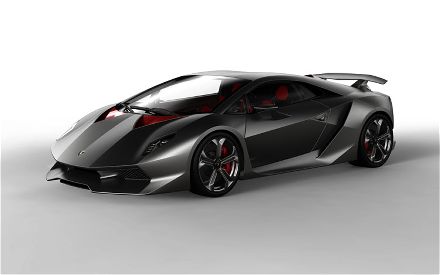
Lamborghini Sesto Elemento Concept


At the 2012 Paris Show, Lamborghini unveiled the Sesto Elemento, the conceptual forerunner to the second-generation Murcielago. Made of carbon-fiber-reinforced plastics (CFRP) virtually from bottom to top, the Sesto Elemento (for "sixth element," because carbon is number six in the periodic table) is said to weigh "under 1000 kilos" (2200 pounds)-and thus it undercuts the 1000-kg mark set by Ferrari with its own lightweight supercar concept, the 2007 Millechili, said to preview the next-generation Enzo. As for Lamborghini's striking two-seater, it uses the chassis and the running gear of the Gallardo Superleggera. It thus is more compact and less extreme than next year's Murcielago replacement, which remains faithful to the big-bore twelve-cylinder engine. 


Says Stephan Winkelmann, CEO and president of Lamborghini: "At Lamborghini, we consider carbon-fiber to be the key for advanced lightweight engineering. That's why we have -- in close cooperation with Boeing and the University of Washington in Seattle -- established in Sant'Agata a carbon fiber competence center." Like every Lamboghini since the Countach, the black beast with the featherweight body is an attention-grabber par excellence. Shaped in-house by the team under Filippo Perini, the sexiest element to come out of Sant'Agata for a long time looks like a crossbreed between a Mattel micro-racer and Darth Vader's next company car. "Ever since the Reventon, we have honed our new form language, which is now chunky, angular, aggressive, purposeful and unmistakably Lamborghini," says Manfred Fitzgerald, the man in charge of brand & design. 

"Sesto Elemente is notably smaller than the Murcielago, but its stance and the proportions are totally in line with the uncompromising tonality of a contemporary mid-engine supercar. While black is the logical color for a carbon-fiber styling exercise, various contrasting red accents add an extra dash of sportiness. After all, this is not a fashion item but a proper street racer. Proving the point are the massive brake cooling ducts, the XXL air intakes and the ground effect properties of the rear apron, the rear undertray, and the prominent rear aerofoil." 

You will be redirected to the script in

seconds