Showing posts with label Hyundai. Show all posts
Wednesday, August 8, 2012
Hyundai SR performance sub-brand in the pipeline
Hyundai Motor Company Australia is looking carefully at the possibilities for
a performance sub-brand under the SR badge to exist alongside its standard model
range.
With the launch of the Hyundai Veloster SR Turbo in Australia this week,
Hyundai is effectively using this high-performance version of the Veloster as a
test case for more SR model variants to be rolled out.
Hyundai has looked at the success of Mazda’s SP range (SP25 and SP20) and is
keen to get a similar model working in Australia with performance versions of
other Hyundai models a possibility if all goes well with the Veloster SR
Turbo.
Product planning manager for Hyundai Motor Company Australia, Andrew Tuitahi,
told CarAdvice that the Veloster SR Turbo “Could become the launch pad for a
range of high-performance Hyundai models similar to what Mazda have with their
SP cars”.
Although unwilling to give too much away, Tuitahi also said “Hyundai would
use the Veloster SR Turbo as a test case for a wider approach to the SR badge in
Australia including the possibility of further performance derivatives of ‘SR’
formula.”
That could mean that Hyundai may even consider a more powerful version still,
such as an ‘R’ edition, similar to the more powerful Mazda3 MPS.
When questioned about the likelihood of an SR version of the Hyundai’s i30,
itself related to the Veloster, he told CarAdvice that “The i30 would make the
most sense given its popularity, but that the earliest Hyundai could communicate
a clear direction for a performance sub-brand would be at the Sydney
International Motor Show, in October.”
Hyundai in Australia is currently the only country in the world to adopt the
SR badge for the Veloster Turbo, as it is known in all other markets including
the United States.
Tuesday, August 7, 2012
Hyundai Prices Standard-Wheelbase 2013 Santa Fe Sport from $25,275
Hyundai made a minor splash at this year’s New York auto show when it
introduced two versions—standard-length Sport and long-wheelbase, uh, LWB—of the
redesigned 2013 Santa Fe crossover. Needless to say, we were only expecting a
single Santa Fe replacement. Either way, the smaller, five-passenger Sport’s
late-summer on-sale date is fast approaching, and today Hyundai released the
model’s pricing info. The stretched, seven-passenger Santa Fe doesn’t go on sale
until next year, so no pricing for that big boy quite yet.
The new Santa Fe Sport can be had with two engines—the base setup is a 190-hp, direct-injected 2.4-liter four, with Hyundai’s turbocharged 2.0-liter four performing step-up motivational duty. In the Santa Fe, the turbo four makes 264 hp, 12 fewer than the outgoing Fe’s 3.5-liter V-6 that it replaces. Both engines can be paired with front- or all-wheel drive; a six-speed automatic is the only transmission option. Full pricing below:
Sport: $25,275 + $1750 for all-wheel drive
2.4L Popular Equipment package ($950) adds roof rails, fog lights, automatic headlights, heated exterior mirrors, power driver’s seat, heated front seats, leather-wrapped steering wheel and shift knob.2.4L Leather and Premium Equipment package ($2950) requires the Popular Equipment package and adds mirrors with turn indicators; proximity key with push button start; leather seats; power front passenger’s seat; sliding, reclining, and heated second-row seats; dual-zone climate control; color audio display; backup camera.2.4L Technology Package ($2700) requires the Leather and Premium Equipment package, to which it adds navigation with an 8-inch touch screen, premium audio system, panoramic sunroof, heated steering wheel, and rear window sunshades.
Sport 2.0T: $28,525 + $1750 for all-wheel drive, adds 19-inch aluminum wheels, proximity key with push button start, and a trailer prep package over base Sport
2.0T Leather and Premium Equipment package ($2450) adds same equipment as 2.4L Leather and Premium package above.2.0T Technology Package ($2900) requires Leather and Premium Equipment package, adds navigation, Infinity 12-speaker audio system, panoramic sunroof, heated steering wheel, and rear window sunshades.
Pricing for every Santa Fe increases substantially over last year, starting with a $1225 bump for the base four-cylinder Sport, followed by a $2575 leap for the front-drive 2.0T compared with the 2012 V-6 model it replaces. The Santa Fe Sport’s base price now comes in above the Chevy Equinox’s, but it’s still lower than that of Ford’s Edge. Look for the Sport to start trickling into dealerships soon.
View the original article here
The new Santa Fe Sport can be had with two engines—the base setup is a 190-hp, direct-injected 2.4-liter four, with Hyundai’s turbocharged 2.0-liter four performing step-up motivational duty. In the Santa Fe, the turbo four makes 264 hp, 12 fewer than the outgoing Fe’s 3.5-liter V-6 that it replaces. Both engines can be paired with front- or all-wheel drive; a six-speed automatic is the only transmission option. Full pricing below:
Sport: $25,275 + $1750 for all-wheel drive
2.4L Popular Equipment package ($950) adds roof rails, fog lights, automatic headlights, heated exterior mirrors, power driver’s seat, heated front seats, leather-wrapped steering wheel and shift knob.2.4L Leather and Premium Equipment package ($2950) requires the Popular Equipment package and adds mirrors with turn indicators; proximity key with push button start; leather seats; power front passenger’s seat; sliding, reclining, and heated second-row seats; dual-zone climate control; color audio display; backup camera.2.4L Technology Package ($2700) requires the Leather and Premium Equipment package, to which it adds navigation with an 8-inch touch screen, premium audio system, panoramic sunroof, heated steering wheel, and rear window sunshades.
Sport 2.0T: $28,525 + $1750 for all-wheel drive, adds 19-inch aluminum wheels, proximity key with push button start, and a trailer prep package over base Sport
2.0T Leather and Premium Equipment package ($2450) adds same equipment as 2.4L Leather and Premium package above.2.0T Technology Package ($2900) requires Leather and Premium Equipment package, adds navigation, Infinity 12-speaker audio system, panoramic sunroof, heated steering wheel, and rear window sunshades.
Pricing for every Santa Fe increases substantially over last year, starting with a $1225 bump for the base four-cylinder Sport, followed by a $2575 leap for the front-drive 2.0T compared with the 2012 V-6 model it replaces. The Santa Fe Sport’s base price now comes in above the Chevy Equinox’s, but it’s still lower than that of Ford’s Edge. Look for the Sport to start trickling into dealerships soon.
View the original article here
Monday, July 23, 2012
2013 Hyundai Veloster Turbo
The standard, 138-hp Hyundai Veloster overpromises and underdelivers. Its
tame, unexceptional dynamics contrast with the wild styling and the curious
three-door package. Yet even as we abandoned our hope for a Korean revelation
during our first drive of that car last October, we remained optimistic that
Hyundai would take a mulligan with the upcoming turbocharged model.
Even before turning a single wheel in the Veloster Turbo, however, our
expectations met harsh reality again this summer when product planners at
Hyundai's U.S. headquarters revealed that the damping, the spring rates, and the
bushings were all left unchanged for the Turbo. We had been hoping for a more
mature setup -- something with the suppleness and sophistication of a Volkswagen
GTI. Instead, the Turbo suffers the same busy, stiff-legged ride over cracks and
heaves as the base car.
Hyundai did address the Veloster's lackluster steering with a rack that is
imperceptibly quicker and a power-assist calibration that is noticeably heavier.
It's a significant step in the right direction, although there's still room for
improvement in on-center responsiveness and feel. Weight remains commendably low
at less than 2900 pounds and the car corners with good body control and a sense
of stability. If the pavement is sufficiently smooth, you can find joy in
stringing together a series of bends, but the Veloster lacks the composure of
its competitors in the most demanding conditions. Thus, piloting the Veloster
Turbo is nowhere near as visceral as the best hot hatches.
It's a similar story with the 1.6-liter four-cylinder. Despite a resume that
includes a twin-scroll turbocharger, dual variable valve timing, direct
injection, and 201 hp and 195 pound-feet of torque (on regular gas), this
overachiever lacks the personality we expected. Power delivery is more linear
than in the similar-sized engines in the Nissan Juke and the Mini Cooper S, but
the Veloster is much less lively. Fuel economy for the manual-transmission car
is rated at 26/38 mpg city/highway, a very impressive number but one that's
telling about the Turbo's character. Rather than a boisterous driver's car,
Hyundai has built yet another 38-mpg small car.
The optional six-speed automatic gains a sport mode in the Turbo that's
supposed to speed up shifts. We say supposed to because it requires an unusually
deep push on the accelerator to elicit a downshift. In fact, the sport mode's
most noticeable change over the standard programming is the unnecessary and
annoying act of locking the transmission out of top gear. Drivers seeking
earlier downshifts and later upshifts will instead need to use the manual shift
mode via the steering-wheel-mounted paddles. Or they can stick with the standard
six-speed manual.
Aesthetically, the Veloster Turbo is even more extroverted than the base car,
with a gaping grille in place of the base car's convoluted fascia. Styling
flourishes like LED accents in the headlights, new tail pipes for the
center-exiting exhaust, 18-inch wheels with chrome accents, and a printed
graphic on the headliner increase the attitude. Others, like the oversized
circular reflectors in the lower rear fascia that could have been sourced from
Home Depot, are less successful. Of all the design tweaks, though, our favorite
is the matte gray paint, a $1000 option that's unique on a vehicle this
affordable. (Just don't drive it through an automated car wash.) Heated,
leather-trimmed seats, an eight-speaker stereo, push-button start, and a
seven-inch touch screen are standard. As per Hyundai convention, the 2013
Veloster Turbo offers excellent infotainment with clear graphics and intuitive
controls for iPhone integration, Bluetooth pairing, and Pandora Internet radio.
Options are limited to a single package that adds navigation, a backup camera
and rear parking sensors, a panoramic sunroof, a 115-volt power outlet, and
automatic headlights for $2500. The automatic transmission adds another $1000 to
the price.
Even with a turbocharger, the Veloster's best attributes remain its value,
fuel economy, and infotainment features. As with the base Veloster, you're more
likely to experience emotions looking at the Turbo than driving it. When it
comes to rational, practical automobiles, Hyundai can hang with the best, but in
trying to capture passion and character, the Koreans are designing when they
need to be engineering.
Price: $22,725
Engine: 1.6L turbo I-4, 201 hp, 195 lb-ft
Transmissions: Six-speed automatic, six-speed manual
Drive: Front-wheel
EPA Mileage: 26/38 mpg (city/highway; manual)
Engine: 1.6L turbo I-4, 201 hp, 195 lb-ft
Transmissions: Six-speed automatic, six-speed manual
Drive: Front-wheel
EPA Mileage: 26/38 mpg (city/highway; manual)
Saturday, July 14, 2012
2013 Hyundai Elantra Coupe
Let's get this out of the way: The 2013 Hyundai Elantra Coupe isn't a driver's automotive. you are not getting to be ripping through Southern California's lovely Pauma Valley -- or the other stretch of squiggly asphalt ribbon, for that matter -- while not quickly encountering the Elantra Coupe's performance limits. Changes are mainly from the rear quarter window back where predictably most of the work was done. The distinctive rear finish options an aesthetic try of chrome exhaust tips flush right integrat into a blacked-out lower fascia. The taillights are slightly reworked, and there is a pronounced rear spoiler on SE models. There are alternative little nip/tucks, as well as slightly completely different rocker panels and minor front finish bits, most notably the blacked-out trapezoidal grille treatment, looking on trim level. The coupe additionally gets its own set of distinctive, optional 17-inch alloys for the SE trim.
Powering the Elantra Coupe is that the same one.8-liter I-4 because the sedan, with 148 horsepower and 131 lb ft of torque mated to either a six-speed manual or automatic. whereas a lot of powerful than the 140-hp Honda Civic coupe (its main bogey) and slightly a lot of economical (29/40 city or highway vs. 28/36 for manual models auto models are each 28/39), we'd have liked to own seen some a lot of horses underneath the hood. we tend to hear an update to the one.8 is within the offing soon, which can little doubt facilitate matters. The 2012 Elantra sedans we've most recently tested ran from 0-60 mph in eight.9 seconds in automatic guise; seven.8 seconds with the manual. on condition that the coupe has roughly an equivalent dimensions and weight because the sedan (other than being zero.4 in. longer),
we'd expect similar numbers. we tend to piloted an automatic-equipped model throughout our drive, which does not prefer to hold a gear when spurred laborious. The coupe might use Hyundai's DCT dual-clutch automatic and a few paddles to travel with it. however when rushed throughout our jaunt in and round the Pauma Valley, it did very little to wow us with its dynamic capabilities despite handling updat specific to the coupe as well as Hyundai s V Beam rear suspension with integrated, Twenty two mm rear stabilizer bar, tun dampers and a revised steering rack. Hyundai has left the door open to any powertrain and suspension updates, which might be welcome news for enthusiast sorts. R-Spec, anyone? If you are within the marketplace for a real performance-themed coupe from Hyundai, there is perpetually the Genesis Coupe or the not-quite-a-coupe Veloster Turbo. however if you are finding out a trendy, sporty-ish, fuel-efficient two-door beginning at a modest worth, the Elantra Coupe is price taking for a spin.
Front-engine, FWD, 5-pass, 2-door coupe one.8L/148-hp/131-lb-ft DOHC 16-valve I-4
Thursday, July 12, 2012
Hyundai i30 Wagon
Hyundai has showed off photos of its new i30 Wagon that will make its world
debut at the Geneva Motor Show next month. The all-new wagon will join the i30
hatchback in Hyundai's European lineup later this year.
We know the i30 hatchback here in the States as the all-new 2013 Hyundai
Elantra GT, which made its debut earlier this month alongside the two-door
Hyundai Elantra Coupe at the Chicago Auto Show. American buyers also get a
third, sedan version of the Elantra, as well.
The new i30 Wagon is powered by the same engines as the Euro i30
Hatchback, including three gas and three diesel engines, ranging from 89 to 133
hp. Overall length of the wagon is up 7.3 inches to 176.6 inches compared the
hatchback, and cargo room behind the rear seats has grown to 18.6 cubic feet;
with the rear seats folded cargo space is more than tripled to nearly 58 cubic
feet.
Hyundai's i30 Wagon was designed alongside the i30 hatchback at Hyundai's
R&D center in Ruesselsheim, Germany, "enabling the stylists to fashion a
coherent design that bears a strong family resemblance inspired by Hyundai's
fluidic sculpture form language," according to Hyundai.
The i30 hatchback and wagon are nearly identical on the front, but from
the B-pillar back the wagon's roofline extends further back giving it a proper
station wagon look while retaining Hyundai's family resemblance.
The rear window
wraps around the D-pillar to decrease blind spots.
The i30 Wagon will be the second bodystyle of the i30 line sold in
Europe, and Hyundai has no plans to bring it across the pond. Should Hyundai
bring a proper Elantra Wagon stateside, for a full lineup of C-segment cars? Or
does the upcoming GT model fill the bill for a practical, yet sporty five-door?
Share your thoughts in the comments below.
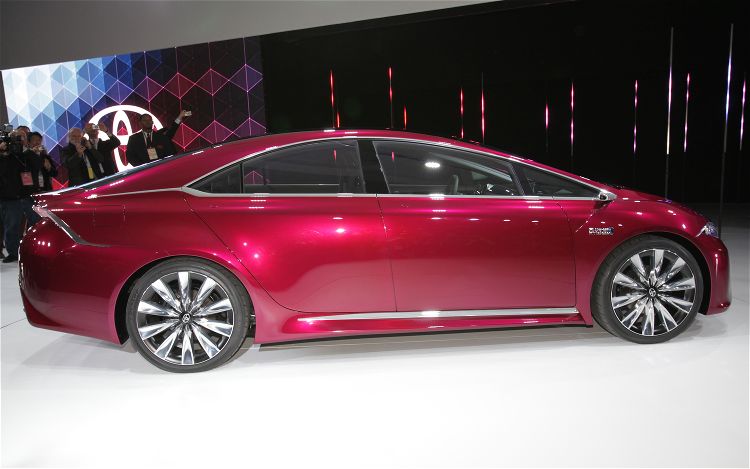
Toyota NS4 Plug-In Hybrid
Toyota unveiled the NS4 plug-in hybrid at the 2012 North American Auto Show.
Toyota is using the NS4 to demonstrate future safety features, connectivity
technology, efficient drivetrain, and design ideas. Many members of the crowd
were expecting to see another variation on the Prius theme and were surprised to
see one of Toyota’s most interesting designs.
Powered by the next-generation of Toyota’s Hybrid Synergy Drive, the NS4
is NOT envisioned as a halo vehicle at the top of the Prius sub-brand, but
rather is meant to indicate that as public interest in alternative powertrain
vehicles increases, HSD will be extended to more non-Prius vehicles. As for that
“next generation” HSD, it features smaller and lighter components, improved
overall fuel economy, better acceleration, longer all-electric range, and a
short charge time, but does NOT adapt a Volt-style drive system that enables the
internal combustion engine to turn the wheels directly for improved efficiency
and permits full-range speed and acceleration in electric mode.
Connectivity is said to be elevated to a new level in the NS4 with a
user-interface that includes a multi-touch screen that looks and feels like a
smartphone. We’re assured that it will be simple and intuitive to operate,
conveying information quickly without distraction while maximizing driver
awareness (didn’t Ford say that about SYNC?). This system is supposedly capable
of “learning” driver preferences and habits to anticipate driver responses in
certain situations. Other interesting features of the liftback sedan include
doors that swing up and out to clear high curbs (like an Aston Martin Rapide’s),
and new hydrophobic glass (naturally sheds water and fog) that manages to reduce
glare and ultraviolet light transmission without blocking radio waves (did you
know that earlier anti-UV glass made some cars shield the signal from
criminal-tracing ankle-bracelets?).
On the safety front, there’s a suite of collision-avoidance systems that
use millimeter-wave radar and stereo-vision cameras to predict and avoid
lane-departure, rear-end, and pedestrian collisions. The headlights are fully
adaptive to provide high-beam illumination while preventing glare when other
cars or pedestrians are present. For now, the NS4 is purely a concept car and we
find all of the tech goodies reasonably interesting, but what we REALLY hope is
that cars like the Camry get a bit of this styling love by 2015–or earlier .
Sunday, July 1, 2012
Hyundai pondering new large crossover
According to a report in Ward s Auto the pale fortunes of the soon-to-depart Hyundai Veracruz are not stopping Hyundai from considering another dedicated seven-seat crossover. though the new Santa Fe can usher in a very long-wheelbased sibling that may seat seven, Hyundai Motor America CEO John Krafcik advises Ward's to "stay tuned for future details on a possible premium crossover" that would be a fanatical – read: Veracruz replacing – CUV for seven.
The question is, what will "premium" mean? The word was applied to the Veracruz however customers did not specifically obtain it, cross-shopping the Veracruz with mass-market competitors. Ward's uses a barn-sized brush to get out the competitive set for this future CUV, from the $18,995 Dodge Journey(!) to the $46,250 Audi Q7. that is a boggling vary, the prime takeaway being that no matter it's are clearly a lot of "premium" than the Veracruz. in keeping with Ward's, "Hyundai has expressed a need to use the rear-wheel drive platform underpinning its premium Genesis and Equus sedans for different models, probably CUVs."
Just as necessary for the instant is that Hyundai believes there is a fight it will still win within the arena of huge crossovers.
Saturday, June 16, 2012
2012 Hyundai Veloster
Hyundai is ready to take the center of their new show of
SEMA on 1st November. Hyundai Veloster ARK performance must be prepared and
presented in a stylish and sports car racing that can steal the spotlight. Ted
Lee, owner, ARK Performance Inc said,”The Hyundai Veloster is an ideal vehicle
for enthusiasts with its distinctive design and dynamic architecture. At SEMA
Show, our ARK Performance Veloster will bridge the realm between an affordable
sports car and an extreme motor sports car. From the first Tiburon, to the
Genesis Coupe, and now with the Hyundai Veloster, ARK Performance continues to
uphold the torch as the pioneer of aftermarket performance manufacturing for
Hyundai.”
ARK Performance is offering several modifications for the exterior and
interior of the Hyundai Veloster, but have also added many engine upgrades that
will surely boost performance.
Just take one look at the Veloster by ARK Performance, and it is perfectly
clear that the tuning firm has changed a variety of the exterior’s elements.
First they added a new front lip, a new grille, wide front and rear fenders, new
side skirts, rear bumper, and a rear wing mounted. Then ARK Performance refined
the lighting a bit with headlamps and taillights and finished up the additions
with a new set of Nitto tires. The body was splashed with a gray exterior color
and highlighted by the neon green accents and graphics.
The inside of the Veloster by ARK Performance is a little more subtle with
new Alcantara seats, as well as an Alcantara covered shift boot, headliner,
dashboard, doors, and visors. There will also be a new audio system and racing
pedals.
ARK has added a new turbo charger and inter cooler system, custom oil cooler,
an inter cooler piping system, turbo manifold, and a lightweight pulley system
to the Veloster’s Gamma 1.6-liter 4-cylinder engine. Stopping power will come
from a 6-pot big brake kit, while an 8-point Chromoly rallies style roll cage
will provide safety measures in case of a crash. Other features include an upper
strut and front and rear sway bar, track coilover system, camber and control
arms, and a dual exhaust system with RSEPC downpipes and test pipes.
Subscribe to:
Posts (Atom)