www.Lookscar.blogspot.com

The Volkswagen Jetta’s long-awaited changeover from the current inline-five-cylinder engine to a turbo four will happen in 2013 for the 2014 model year, the company’s U.S. product czar Rainer Michel told us this week. Soon after, Michel says, the engine will land in a 2014.5 model-year Passat. This confirms the timing we heard earlier from a different—and has-to-stay-nameless—source.

www.Lookscar.blogspot.com

The BMW 328i Luxury's logbook had finally cooled down after a disappointing trip to the local road course when something else happened: the weather heated up. Between surviving one choice mishap and dealing with sweltering temperatures, our BMW has had a rough month.

www.Lookscar.blogspot.com

Vorsteiner has created a new aero package for the already gorgeous 458. This includes a front spoiler, side skirts and a revised rear diffuser. This is combined with specialised 21 inch rims. All parts are made out of carbon fibre.

www.Lookscar.blogspot.com

Spanish specialty carmaker Aspid Cars has dropped the primary teaser pictures of its new GT-21 Invictus, a 2+2 seater sports automotive. this is often Aspid's second vehicle series when the hardcore Super Sports (SS), which sort of resembles a Lotus seven on steroids.

www.Lookscar.blogspot.com

The version of the ATS that Cadillac meant to spice up the company’s overall fuel-economy numbers has simply received a rather lackluster rating from the EPA. With a Two hundred-hp, 2.5-liter four-cylinder engine, the ATS is rated at simply twenty two town mpg and thirty three highway.

Wednesday, August 8, 2012

Hyundai SR performance sub-brand in the pipeline


Hyundai Motor Company Australia is looking carefully at the possibilities for a performance sub-brand under the SR badge to exist alongside its standard model range.

With the launch of the Hyundai Veloster SR Turbo in Australia this week, Hyundai is effectively using this high-performance version of the Veloster as a test case for more SR model variants to be rolled out.

Hyundai has looked at the success of Mazda’s SP range (SP25 and SP20) and is keen to get a similar model working in Australia with performance versions of other Hyundai models a possibility if all goes well with the Veloster SR Turbo.

Product planning manager for Hyundai Motor Company Australia, Andrew Tuitahi, told CarAdvice that the Veloster SR Turbo “Could become the launch pad for a range of high-performance Hyundai models similar to what Mazda have with their SP cars”.


Although unwilling to give too much away, Tuitahi also said “Hyundai would use the Veloster SR Turbo as a test case for a wider approach to the SR badge in Australia including the possibility of further performance derivatives of ‘SR’ formula.”

That could mean that Hyundai may even consider a more powerful version still, such as an ‘R’ edition, similar to the more powerful Mazda3 MPS.

When questioned about the likelihood of an SR version of the Hyundai’s i30, itself related to the Veloster, he told CarAdvice that “The i30 would make the most sense given its popularity, but that the earliest Hyundai could communicate a clear direction for a performance sub-brand would be at the Sydney International Motor Show, in October.”

Hyundai in Australia is currently the only country in the world to adopt the SR badge for the Veloster Turbo, as it is known in all other markets including the United States.

Mazda Goes on a Diet, Plans Weight Reductions for Every New Model


A report in Automotive News reveals a lofty goal for Mazda: reduce the weight of new-generation cars by 220 pounds compared to the outgoing model. This is part of the automaker’s plan to reach another lofty goal, namely achieving a 30-percent improvement in its global corporate fuel-economy average by 2015. Both fit under the company’s long-term Sustainable Zoom-Zoom banner and fit into its internal Building Block Strategy designed to optimize all aspects of vehicle design while integrating evolving technologies such as hybrids and electric vehicles.

Although 220 pounds—which equals a nice, round 100 kilograms—seems an almost arbitrary figure, Dave Coleman, vehicle development engineer for Mazda’s North American operations, tells us that the actual amount of weight reduction per vehicle will vary, but the figure represents a “high-level goal.” He adds that the figure only applies to all-new models, not midcycle refreshes.

Using the recently redesigned Mazda CX-5 to illustrate, Coleman pointed out how replacing a formerly difficult-to-weld assembly with a welding/bonding adhesive process allowed engineers to spread the load throughout the body, reducing the amount of material needed without compromising the structural integrity.
So far, the plan doesn’t include the extensive use of aluminum, carbon fiber, or other exotic materials: “We think there is still room for improvement by using high-tensile steel and intelligent design to optimize the structure,” said Coleman. Of course, a 220-pound reduction will affect a Miata and a CX-9 differently, not to mention the fact that this kind of weight loss, no matter how much we’d like it to, can’t last for too many generations. Otherwise, the cars would eventually be weightless, and then where would we be?

Tuesday, August 7, 2012

France Wants the European Union to Monitor South Korean Car Exports


The spike in South Korean car sales in Europe the past few years has the French worried as at the same time they are seeing their numbers drop amidst the debt crisis that has engulfed the continent. 

Just last year, sales of Korean cars in the European Union grew 24 percent, even though the overall market contracted. French carmakers, on the other hand, saw their sales drop with PSA Peugeot Citroen announcing plans to slash 8,000 jobs. 

As a result, France has officially sent a request to the EU Commission to monitor South Korean car exports, a move seen by many analysts as the first step to a possible re-introduction of tariffs only a year after a free-trade deal with the Asian country came into effect. 

"The European Commission confirms it has received a note from the French authorities requesting ... prior surveillance measures for South Korean car imports," EU Trade Spokesman John Clancy said in a statement. "The Commission is reviewing carefully the request." 


If the EU accepts France's request, local carmakers will be able to obtain detailed information including the type and number of products scheduled for export to Europe before the cars arrive from South Korea.
In the event that the EU Commission takes one more step and scraps the free-trade agreement with Seoul, then Europe will be able to impose protectionist restrictions to South Korean exports. 

However, as pointed out by Reuters that broke the story, despite the fact that South Korean exports to the EU grew by 40 percent to 345,000 units since the deal was signed on July 1, 2011, that number is well below the 640,000 units imported in 2007. 

The reason for this discrepancy is that South Korean carmakers like Hyundai and Kia have increased their production capacity in European factories in the Czech Republic and Turkey. 

"The growth of Hyundai in Europe is based on products designed, engineered and built in Europe," Andreas Brozat, a spokesman for Hyundai told Reuters. "Less than 12 percent of the 232,454 Hyundai cars registered in Europe during the first half of 2012 were built in Korea, while 70 percent came from the European region." 

2013 Porsche Boxster S Instrumented Test


"Leaving well enough alone” doesn’t translate into German, especially the dialect spoken by Porsche engineers. Witness the new, judiciously polished Boxster, a machine that advances the modern sports car. 

As before, the new Boxster is essentially a 911 with its engine set in the middle, which is where Dr. and Ferry Porsche intended it to be in the first place. In spite of a 2.3-inch-longer wheelbase and modest track-width bumps, the Boxster S is 77 pounds lighter than before, thanks to increased use of aluminum and magnesium. Length is up 0.1 inch, and width is unchanged; torsional stiffness is 40 percent greater. Spreading the footprints and moving the windshield’s base forward stretches legroom by an inch. The price starts at a reasonable $61,850, then rockets into outer space when you succumb to the options list.

The most notable chassis change is a switch from hydraulic to electric assistance for the rack-and-pinion steering. With the goal of improved ride and handling, the carry-over four-corner strut suspension benefits from an expert massage. Larger front brakes are shared with the 911; 19-inch wheels are now standard (20s are optional). The engineers coaxed an extra five horsepower out of the direct-injected 3.4-liter flat-six, raising peak output to 315 horses at 6700 rpm while boosting the redline from 7400 to 7600 rpm and improving gas mileage by 1–2 mpg.


Compared with the dual-clutch-automatic-equipped Boxster S that thumped arch rivals in a comparo three years ago [July 2009], the new stick-shift 2013 model we tested is superior in every performance category except acceleration. The dual-clutch transmission’s launch control and uninterrupted power delivery during upshifts are tough to beat; the new S comes close with a 4.4-second leap to 60 versus the previous automatic’s 4.3. The old and new Porsches cross the quarter-mile mark in a 12.9-second dead heat, beyond which the new S’s taillamps wink goodbye on the way to a 176-mph top speed. The 20-inch Pirelli P Zeroes and other chassis upgrades boost skidpad stick from 0.94 to 0.99 g and clip a significant eight feet from the 70-to-0-mph stopping distance.

Despite all this improved performance, the Boxster S’s disposition remains cheerful. The driver-to-controls interface is absolute perfection, the shifter stirs gears like a Food Network chef, and heel-and-toe pedal work is child’s play. The optional Adaptive Sport seats (part of a $5265 Premium package) offer 18-way adjustability and outstanding comfort and support.

With the tight-fitting, well-insulated top up, the engine is subdued until you summon its inner beast at 5500 rpm. The engine’s mating calls are best appreciated with the top down. Touch a button with the car moving at no more than 30 mph, and the lid folds in 10 seconds. With no structural shake and minimal wind ruckus at 100 mph, this convertible eliminates most excuses for buying a coupe.


Adaptive dampers costing an extra $1790 are a must, providing a supple ride and supreme control for on-ramp and track sessions. Flick the wheel, and the Boxster S replays all the lessons it learned at the Nordschleife. Push hard in corners, and you’ll find understeer; lift abruptly off the throttle, and the front scrub becomes an easy-to-control four-wheel pirouette. The steering is quick to respond and perfectly weighted. Even with most of the road-surface bump and grind filtered out by the new electric power assist, the Boxster S’s steering wheel still provides a satisfying handshake. Likewise, the brake pedal is firm and easy to modulate when you slow for a bend below the ABS threshold. 

VEHICLE TYPE: mid-engine, rear-wheel-drive, 2-passenger, 2-door roadster
PRICE AS TESTED: $85,410
BASE PRICE: $61,850
ENGINE TYPE: DOHC 24-valve flat-6, aluminum block and heads, direct fuel injection
Displacement: 210 cu in, 3436 cc
Power: 315 hp @ 6700 rpm
Torque: 266 lb-ft @ 4500 rpm
TRANSMISSION: 6-speed manual
DIMENSIONS:
Wheelbase: 97.4 in
Length: 172.2 in
Width: 70.9 in Height: 50.0 in
Curb weight: 3070 lb 

C/D TEST RESULTS:
Zero to 60 mph: 4.4 sec
Zero to 100 mph: 10.5 sec
Zero to 150 mph: 28.2 sec
Rolling start, 5–60 mph: 5.3 sec
Standing ¼-mile: 12.9 sec @ 111 mph
Top speed (drag limited): 176 mph
Braking, 70–0 mph: 147 ft
Roadholding, 300-ft-dia skidpad: 0.99 g

FUEL ECONOMY (C/D EST):
EPA city/highway driving: 20/28 mpg
C/D observed: 19 mpg

2012 Honda Civic Si Long-Term Update 3


Six months and ten thousand miles have passed since the Honda Civic Si has arrived and I have really adopted it as my own. The seat is always adjusted correctly and my phones Bluetooth auto-connects when I turn on the stereo. So what kind of impression has the Civic left on me? Well, Honda Civic ownership is very uneventful. Everyone I have talked to agrees that the Civic is an overall good looking car, but you don't exactly catch little kids staring at it in awe on the freeway. There little that anyone would find offensive but there is also little to find interesting. Driving, especially high in the rev-range can be enjoyable, but power isn't its strong suit and I always expect it to pull a little harder than it does, especially considering the noise it makes. 


It also has an annoying habit of holding revs for the second or so after the clutch is depressed. Due to its irregularity, I can't decide if this is by design or if its a defect. Then there is the mysterious knock in the rear suspension that comes and goes and has yet to be heard or diagnosed by any of the friendly folks at my local Honda dealer. This sensation is not exclusive to the uber-rich either, either. One of the most fun cars I have ever driven is my mom's 2003 Dodge Neon SRT-4, which competed with a Civic Si in its day. When producing a sports version of a base economy car, it really needs to feel different and exciting, like the SRT-4. To use a more modern example, take the Subaru Impreza WRX STI. It has spoilers, scoops, a brawny looking wide-body kit, and a tightly-wound turbocharged 2.5-liter engine. Every part of the car feels meaner, sharper, and more hardcore than the base Impreza. Its that feeling that I wih the Civic had more of, that extra character and passion. 

Capristo Crafts a Lighter and Faster Lamborghini


While mostly known for its custom exhaust systems, Germany-based Capristo also develops other parts for sports and super cars like the Ferrari 458 Italia and in this case, the new Lamborghini Aventador LP700-4.
With the raging bull model, Capristo's goal was to increase performance through a specially developed exhaust system and by reducing the Aventador's weight. 

In stock form, the all-wheel drive Lamborghini model is fitted with a 6.5-liter V12 engine delivering 691hp (700PS) and it tips the scales at 1,575kg or 3,472 pounds. 

Capristo's engineers began by stripping down the Aventador to its components and found a number of parts that could be replaced with lighter carbon-fibre composite materials formed in the same shape and styling of the original parts. 


These included the front and rear aprons, rear diffuser, front grille, mirror housings, air intakes and even the trunk liner and engine compartment panels. All told, Capristo was able to shave 40kg (88 pounds) while also improving the performance of the V12 engine thanks to the new exhaust system. 

While the tuning brand did not reveal how many horses were gained with the exhaust system, it did say that these changes help the Aventador reach 100km/h (62mph) 0.1 seconds faster than the regular model at 2.8 seconds, while top speed increases by 3km/h (2mph) to 354km/h (220mph). 

Capristo said that it also working on cutting weight from the underbody, wheel housings and sills with details to be released in the near future.  

Hyundai Prices Standard-Wheelbase 2013 Santa Fe Sport from $25,275

 
Hyundai made a minor splash at this year’s New York auto show when it introduced two versions—standard-length Sport and long-wheelbase, uh, LWB—of the redesigned 2013 Santa Fe crossover. Needless to say, we were only expecting a single Santa Fe replacement. Either way, the smaller, five-passenger Sport’s late-summer on-sale date is fast approaching, and today Hyundai released the model’s pricing info. The stretched, seven-passenger Santa Fe doesn’t go on sale until next year, so no pricing for that big boy quite yet.

The new Santa Fe Sport can be had with two engines—the base setup is a 190-hp, direct-injected 2.4-liter four, with Hyundai’s turbocharged 2.0-liter four performing step-up motivational duty. In the Santa Fe, the turbo four makes 264 hp, 12 fewer than the outgoing Fe’s 3.5-liter V-6 that it replaces. Both engines can be paired with front- or all-wheel drive; a six-speed automatic is the only transmission option. Full pricing below:

Sport: $25,275 + $1750 for all-wheel drive
2.4L Popular Equipment package ($950) adds roof rails, fog lights, automatic headlights, heated exterior mirrors, power driver’s seat, heated front seats, leather-wrapped steering wheel and shift knob.2.4L Leather and Premium Equipment package ($2950) requires the Popular Equipment package and adds mirrors with turn indicators; proximity key with push button start; leather seats; power front passenger’s seat; sliding, reclining, and heated second-row seats; dual-zone climate control; color audio display; backup camera.2.4L Technology Package ($2700) requires the Leather and Premium Equipment package, to which it adds navigation with an 8-inch touch screen, premium audio system, panoramic sunroof, heated steering wheel, and rear window sunshades.

Sport 2.0T: $28,525 + $1750 for all-wheel drive, adds 19-inch aluminum wheels, proximity key with push button start, and a trailer prep package over base Sport

2.0T Leather and Premium Equipment package ($2450) adds same equipment as 2.4L Leather and Premium package above.2.0T Technology Package ($2900) requires Leather and Premium Equipment package, adds navigation, Infinity 12-speaker audio system, panoramic sunroof, heated steering wheel, and rear window sunshades.

Pricing for every Santa Fe increases substantially over last year, starting with a $1225 bump for the base four-cylinder Sport, followed by a $2575 leap for the front-drive 2.0T compared with the 2012 V-6 model it replaces. The Santa Fe Sport’s base price now comes in above the Chevy Equinox’s, but it’s still lower than that of Ford’s Edge. Look for the Sport to start trickling into dealerships soon.

View the original article here

Monday, August 6, 2012

First drive: the new Cadillac ATS


What's this ATS all about? Looks like a shrunken Cadillac CTS.
And that's essentially what it is. Only it isn't as the ATS is an entirely new car built off a completely, all-new-from-the-ground-up platform. Car companies, least of all luxury ones, don't get to build new platforms - the basic fabric of a car other than the body - very often as they cost an immense amount of time and cash. So this ATS saloon is not the only car that is going to be built off it. Apart from all the ATS model derivatives, the ATS's skeleton and nervous system will be reworked for the next Camaro, the refreshed CTS and a new Chevrolet compact coupe, which we know only as the 130R concept car so far.

OK, so it's the smallest Cadillac?
Yes, think of the ATS as a BMW 3 Series competitor. As that's exactly what it was conceived and designed to beat. Cadillac has watched as the 3 Series has become the default luxury compact car in the US, and has had to wait until now to bring the fight to it. It's a massive task to try and topple the Bavarian uber saloon, but Cadillac reckons the rear-drive ATS is the car to do it.
See more pictures of the Cadillac ATS

OK, but it's not just about performance models, what are the regular cars like to drive?
Good to great. We got to drive everything from the base 2.5-litre manual model all the way up to the 3.6-litre V6 variant and the general impression on the road is that the chassis guys have really done their homework. Super smooth ride, good steering feel and quiet, finely controlled suspension let you know immediately that this car means business. The base engine is a little coarse when extended and the smooth 3.6 bent six will please the more mature driver, but the sweet spot is the two-litre turbo unit, especially when it's mated to the tap-shift auto gearbox. In this configuration the ATS gels into a back road weapon that has you snipping up and down gears and slicing through corners just for fun. Word of caution: do not spec the manual.

How do you know that?
We got to drive the ATS on a short race track in Atlanta that felt like it had been designed - by F1 guru Herman Tilke, no less - after a blast across some hilly British countryside. Just fewer sheep on the road. The 50/50 front/rear ATS was completely linear and rock solid throughout, to the point that you start to think you are a better driver than you are. That kind of flattery is always welcome - and rare.

So, better than a 3 Series then?
At the limit, it really does feel that way. On the road, the fight is more even. The ATS's cabin doesn't have the BMW's super modern feel, settling for a more traditional stitched leather approach, which will please some and deter others. But it does have some nice, unique touches. The CUE control centre is big, bold and easy to use with words - it understands ordinary language instead of expecting you to speak like a robot - or fingers. And there is BOSE active noise cancelling, which keeps the cabin free of unwanted noise, just like your headphones on an aeroplane.

Specs (as tested)
2,457cc, 4cyl, RWD, 260bhp, 353lb-ft, 27mpg, CO2 n/a, 0-60mph 5.7secs, 155mph (est), 1530kg
Price 
From $33,990 (£21,883)


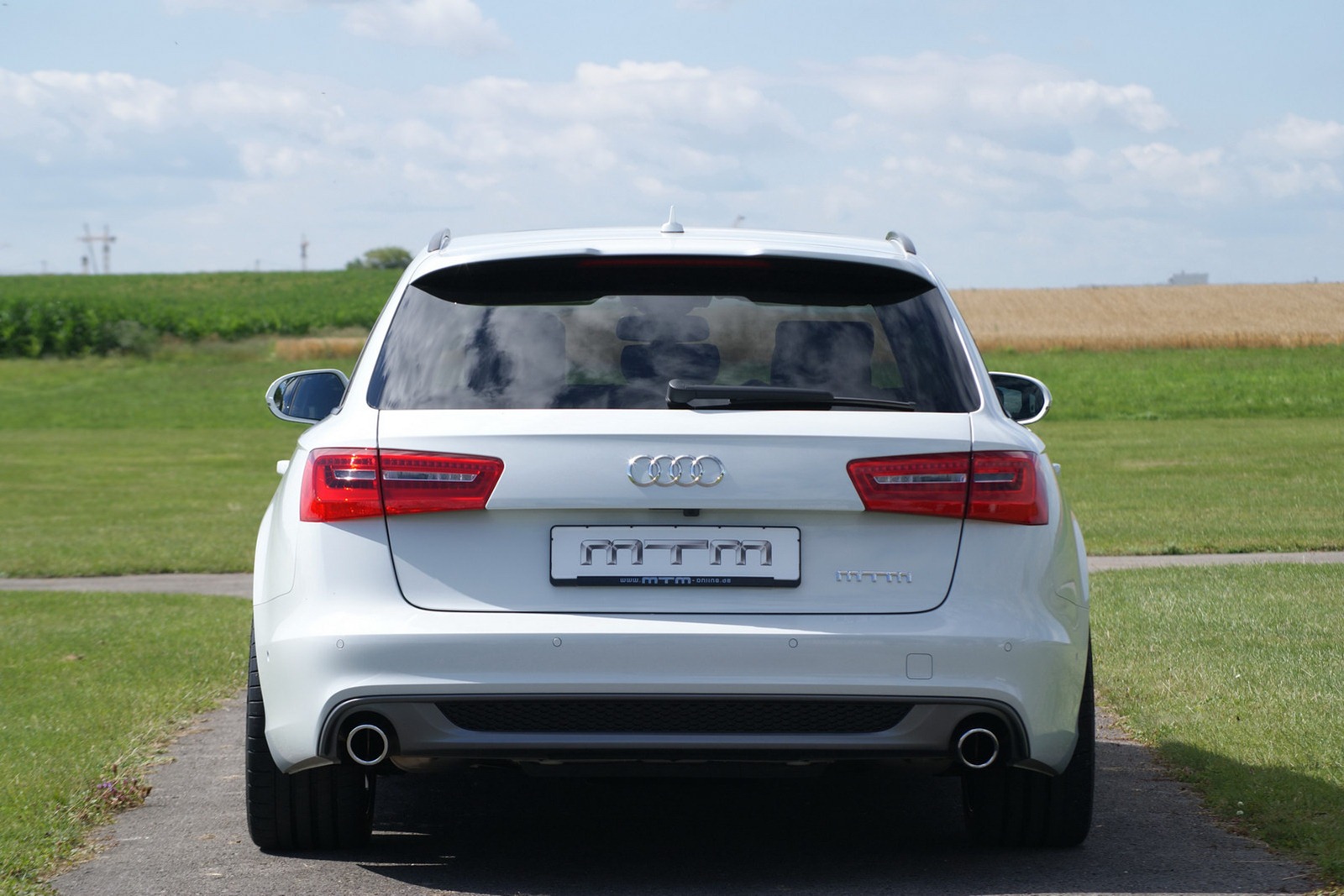
MTM Infuses Audi A6 3.0 BiTD with 376-Horses


Not that the Audi A6 3.0 BiTD in either Avant or sedan trims lacks the oomph, but if you're in need of more power and improved handling, then you may want to look at what Germany's MTM has prepared for the Four Ring brand's executive model. 

The fine-tuning starts from the engine bay where MTM engineers upgrade the V6 unit's software boosting output and peak torque from 309hp (313PS) and 650Nm (479 lb-ft) to 376hp (381PS) and 780Nm (575 lb-ft) respectively. 

The cost for the ECU optimization is set at €1,800 (US$2,230) while MTM also offers a slightly less powerful version at 360hp (365PS) and 760Nm (560 lb-ft) for €100 less. 


To improve the diesel-powered A6's stopping power, MTM has developed two different brake sets. The first one comes with 380 X 34 mm discs, stainless-steel-flex-line and eight-piston calipers priced at €4,900 (US$6,070), while the second set with uprated 405 X 36 mm discs at a cost of €6,400 (US$7,930). 

Next up on MTM's menu is the €1,740 (US$2,160) F-Cantronic ECU upgrade for the air suspension that allows the driver to drop the ride height by up to 25mm at the front axle and 20mm at the rear. 

Last but not least, the German tuner offers a variety of alloy wheel designs in sizes from 18- to 20 inches priced from €1,730 to €5,230 (US$2,140-US$6,480).  

Nagel Dakkar is the Dartz of all SUVs…and Then Some More


Dartz, the Latvia-based company that will be forever remembered for the Prombron Monaco Red Diamond Edition with its true- and then faux-whale penis leather dressed interior, has returned with an announcement for a new future product. 

The firm's new model is named Nagel Dakkar after Russian racing driver Andrew Nagel who the 1912 Monte Carlo Rally. 

Always up for a joke (we assume…), Dartz has this to say about the Nagel Dakkar: "This won't be just new car model - will be new class of cars we call it B.N.U.D.S."
And since you're surely wondering what B.N.U.D.S. stands for, we will allow Dartz's unedited press release to do the explaining:
Bespoke - as every car will be made specially for You
Noble - as this car will be sold under world one of the oldest car labels
Urban - as will be excellent for city ride - and doesn't matter narrows streets of Monaco, of wide highway in LA.
Desert - car will be bsed on tubular frame and designed by famous SAM - Saxon Automobile Manufactur which is wellknown with their rally car with all perfomance issues
Safety - using titanium tubular farme in new car will be achieved unseen before safety for "civil" cars."
The Latvian company released two different renderings of the Nagel Dakkar, a pencil sketch by its own Alex Isaev and a more professional looking CGI made by German designer Pochwatta. 

Dartz says the body and the interior of the SUV will be customizable while the underpinnings will remain the same and include a 650hp Mercedes-Benz AMG 5.5-liter bi-turbocharged V8 engine. 

Production will start in 2013 with prices for the base model ranging from €250,000 to €300,000 when it comes to Euro notes and $390,000 to $468,000 if you pay in good ol' US dollars – we have no idea why there's a difference between the two currencies. 

For more things that don't make much sense, hop over the break to read the rest of the press release from Dartz.

Story References: Dartz via Autoblog.nl
Dartz Press Release:
Attached - scetches from two car designers we are working with - DARTZ stuff designer Alex Isaev (pencil pictures) and German designer Pochwatta.
Our joint team now are in discussion how will look future, and - as we are bespoke car builders - may be it will have different bodies.
That's for sure, as our customers must have choise.
As all we know no ladie will come to party in same dress as other.
But, yes, they always come to this party in same cars.
yes, expensive, yes luxury - but - YES - similar.
DARTZ-SAM car will solve that issue, as on titanium frame we can put on "dress' or car body you want, you choose, you dream.
DARTZ-SAM will world one&only unique car which will mix highest quality of german engeneering and car building traditions with insane russian luxury.
DARTZ-SAM will be favorite car in Your garage - as when you will wake up don't knowing what's your plans for today, you can easy jump in in DARTZ-SAM - you can go off-road, all-road, or any-road.
DARTZ-SAM - car where you can make billions, like in business-pullman, and non-stop go to win rally.
WHY NOT? You work hard - You deserve it!
DARTZ-SAM plans is to get as minimum 1,3% of world luxury SUV market, but that's minimum, DARTZ already get request from Chinese government company which they signed contract at 2011.
As uniting of such out-of-box thinking teams look very promising.
Wealthy people need personalized cars and there are ten's of bespoke sportcars makers - but there are zero bespoke SUV makers.
That make people to buy regular SUV's and invest hundred's of thousands to upgrade them.
But anycase this are just regular cars, with expensive, but regular upgrade.

DARTZ-SAM sales plan on nearest years:2013 10 units
2014 20 units
2015 40 units
2016 40 units
2017 40 units

Car price is planned Eur 250,000 - 300,000 for base model.
$390,000-$468,000

car specifications:Engine
8 cylinder AMG Mercedes V8 Bi-turbo
Capacity 5.5L
Performance 650 HP, 850 Nm (626 lb ft)
Top speed 250 km/h
Drive train
Gearbox 7
gear double clutch gearbox
Clutch AP Racing
Sinter metallic Differentials Sadev
Body
Titanium tubular frame chassis Base for all the vehicles
Carbon Kevlar chassis Extremely light
Dimensions
Length 4620 mm (4-door / 4920mm)
Width 2000 mm Height 1700 mm (250 mm clearance)
Unloaded weight 1890 kgs / 1990 kgs
Wheel base 2910 mm (4-door / 3210mm) 

You will be redirected to the script in

seconds