www.Lookscar.blogspot.com

The Volkswagen Jetta’s long-awaited changeover from the current inline-five-cylinder engine to a turbo four will happen in 2013 for the 2014 model year, the company’s U.S. product czar Rainer Michel told us this week. Soon after, Michel says, the engine will land in a 2014.5 model-year Passat. This confirms the timing we heard earlier from a different—and has-to-stay-nameless—source.

www.Lookscar.blogspot.com

The BMW 328i Luxury's logbook had finally cooled down after a disappointing trip to the local road course when something else happened: the weather heated up. Between surviving one choice mishap and dealing with sweltering temperatures, our BMW has had a rough month.

www.Lookscar.blogspot.com

Vorsteiner has created a new aero package for the already gorgeous 458. This includes a front spoiler, side skirts and a revised rear diffuser. This is combined with specialised 21 inch rims. All parts are made out of carbon fibre.

www.Lookscar.blogspot.com

Spanish specialty carmaker Aspid Cars has dropped the primary teaser pictures of its new GT-21 Invictus, a 2+2 seater sports automotive. this is often Aspid's second vehicle series when the hardcore Super Sports (SS), which sort of resembles a Lotus seven on steroids.

www.Lookscar.blogspot.com

The version of the ATS that Cadillac meant to spice up the company’s overall fuel-economy numbers has simply received a rather lackluster rating from the EPA. With a Two hundred-hp, 2.5-liter four-cylinder engine, the ATS is rated at simply twenty two town mpg and thirty three highway.

Tuesday, August 7, 2012

2012 Honda Civic Si Long-Term Update 3


Six months and ten thousand miles have passed since the Honda Civic Si has arrived and I have really adopted it as my own. The seat is always adjusted correctly and my phones Bluetooth auto-connects when I turn on the stereo. So what kind of impression has the Civic left on me? Well, Honda Civic ownership is very uneventful. Everyone I have talked to agrees that the Civic is an overall good looking car, but you don't exactly catch little kids staring at it in awe on the freeway. There little that anyone would find offensive but there is also little to find interesting. Driving, especially high in the rev-range can be enjoyable, but power isn't its strong suit and I always expect it to pull a little harder than it does, especially considering the noise it makes. 


It also has an annoying habit of holding revs for the second or so after the clutch is depressed. Due to its irregularity, I can't decide if this is by design or if its a defect. Then there is the mysterious knock in the rear suspension that comes and goes and has yet to be heard or diagnosed by any of the friendly folks at my local Honda dealer. This sensation is not exclusive to the uber-rich either, either. One of the most fun cars I have ever driven is my mom's 2003 Dodge Neon SRT-4, which competed with a Civic Si in its day. When producing a sports version of a base economy car, it really needs to feel different and exciting, like the SRT-4. To use a more modern example, take the Subaru Impreza WRX STI. It has spoilers, scoops, a brawny looking wide-body kit, and a tightly-wound turbocharged 2.5-liter engine. Every part of the car feels meaner, sharper, and more hardcore than the base Impreza. Its that feeling that I wih the Civic had more of, that extra character and passion. 

Capristo Crafts a Lighter and Faster Lamborghini


While mostly known for its custom exhaust systems, Germany-based Capristo also develops other parts for sports and super cars like the Ferrari 458 Italia and in this case, the new Lamborghini Aventador LP700-4.
With the raging bull model, Capristo's goal was to increase performance through a specially developed exhaust system and by reducing the Aventador's weight. 

In stock form, the all-wheel drive Lamborghini model is fitted with a 6.5-liter V12 engine delivering 691hp (700PS) and it tips the scales at 1,575kg or 3,472 pounds. 

Capristo's engineers began by stripping down the Aventador to its components and found a number of parts that could be replaced with lighter carbon-fibre composite materials formed in the same shape and styling of the original parts. 


These included the front and rear aprons, rear diffuser, front grille, mirror housings, air intakes and even the trunk liner and engine compartment panels. All told, Capristo was able to shave 40kg (88 pounds) while also improving the performance of the V12 engine thanks to the new exhaust system. 

While the tuning brand did not reveal how many horses were gained with the exhaust system, it did say that these changes help the Aventador reach 100km/h (62mph) 0.1 seconds faster than the regular model at 2.8 seconds, while top speed increases by 3km/h (2mph) to 354km/h (220mph). 

Capristo said that it also working on cutting weight from the underbody, wheel housings and sills with details to be released in the near future.  

Hyundai Prices Standard-Wheelbase 2013 Santa Fe Sport from $25,275

 
Hyundai made a minor splash at this year’s New York auto show when it introduced two versions—standard-length Sport and long-wheelbase, uh, LWB—of the redesigned 2013 Santa Fe crossover. Needless to say, we were only expecting a single Santa Fe replacement. Either way, the smaller, five-passenger Sport’s late-summer on-sale date is fast approaching, and today Hyundai released the model’s pricing info. The stretched, seven-passenger Santa Fe doesn’t go on sale until next year, so no pricing for that big boy quite yet.

The new Santa Fe Sport can be had with two engines—the base setup is a 190-hp, direct-injected 2.4-liter four, with Hyundai’s turbocharged 2.0-liter four performing step-up motivational duty. In the Santa Fe, the turbo four makes 264 hp, 12 fewer than the outgoing Fe’s 3.5-liter V-6 that it replaces. Both engines can be paired with front- or all-wheel drive; a six-speed automatic is the only transmission option. Full pricing below:

Sport: $25,275 + $1750 for all-wheel drive
2.4L Popular Equipment package ($950) adds roof rails, fog lights, automatic headlights, heated exterior mirrors, power driver’s seat, heated front seats, leather-wrapped steering wheel and shift knob.2.4L Leather and Premium Equipment package ($2950) requires the Popular Equipment package and adds mirrors with turn indicators; proximity key with push button start; leather seats; power front passenger’s seat; sliding, reclining, and heated second-row seats; dual-zone climate control; color audio display; backup camera.2.4L Technology Package ($2700) requires the Leather and Premium Equipment package, to which it adds navigation with an 8-inch touch screen, premium audio system, panoramic sunroof, heated steering wheel, and rear window sunshades.

Sport 2.0T: $28,525 + $1750 for all-wheel drive, adds 19-inch aluminum wheels, proximity key with push button start, and a trailer prep package over base Sport

2.0T Leather and Premium Equipment package ($2450) adds same equipment as 2.4L Leather and Premium package above.2.0T Technology Package ($2900) requires Leather and Premium Equipment package, adds navigation, Infinity 12-speaker audio system, panoramic sunroof, heated steering wheel, and rear window sunshades.

Pricing for every Santa Fe increases substantially over last year, starting with a $1225 bump for the base four-cylinder Sport, followed by a $2575 leap for the front-drive 2.0T compared with the 2012 V-6 model it replaces. The Santa Fe Sport’s base price now comes in above the Chevy Equinox’s, but it’s still lower than that of Ford’s Edge. Look for the Sport to start trickling into dealerships soon.

View the original article here

Monday, August 6, 2012

First drive: the new Cadillac ATS


What's this ATS all about? Looks like a shrunken Cadillac CTS.
And that's essentially what it is. Only it isn't as the ATS is an entirely new car built off a completely, all-new-from-the-ground-up platform. Car companies, least of all luxury ones, don't get to build new platforms - the basic fabric of a car other than the body - very often as they cost an immense amount of time and cash. So this ATS saloon is not the only car that is going to be built off it. Apart from all the ATS model derivatives, the ATS's skeleton and nervous system will be reworked for the next Camaro, the refreshed CTS and a new Chevrolet compact coupe, which we know only as the 130R concept car so far.

OK, so it's the smallest Cadillac?
Yes, think of the ATS as a BMW 3 Series competitor. As that's exactly what it was conceived and designed to beat. Cadillac has watched as the 3 Series has become the default luxury compact car in the US, and has had to wait until now to bring the fight to it. It's a massive task to try and topple the Bavarian uber saloon, but Cadillac reckons the rear-drive ATS is the car to do it.
See more pictures of the Cadillac ATS

OK, but it's not just about performance models, what are the regular cars like to drive?
Good to great. We got to drive everything from the base 2.5-litre manual model all the way up to the 3.6-litre V6 variant and the general impression on the road is that the chassis guys have really done their homework. Super smooth ride, good steering feel and quiet, finely controlled suspension let you know immediately that this car means business. The base engine is a little coarse when extended and the smooth 3.6 bent six will please the more mature driver, but the sweet spot is the two-litre turbo unit, especially when it's mated to the tap-shift auto gearbox. In this configuration the ATS gels into a back road weapon that has you snipping up and down gears and slicing through corners just for fun. Word of caution: do not spec the manual.

How do you know that?
We got to drive the ATS on a short race track in Atlanta that felt like it had been designed - by F1 guru Herman Tilke, no less - after a blast across some hilly British countryside. Just fewer sheep on the road. The 50/50 front/rear ATS was completely linear and rock solid throughout, to the point that you start to think you are a better driver than you are. That kind of flattery is always welcome - and rare.

So, better than a 3 Series then?
At the limit, it really does feel that way. On the road, the fight is more even. The ATS's cabin doesn't have the BMW's super modern feel, settling for a more traditional stitched leather approach, which will please some and deter others. But it does have some nice, unique touches. The CUE control centre is big, bold and easy to use with words - it understands ordinary language instead of expecting you to speak like a robot - or fingers. And there is BOSE active noise cancelling, which keeps the cabin free of unwanted noise, just like your headphones on an aeroplane.

Specs (as tested)
2,457cc, 4cyl, RWD, 260bhp, 353lb-ft, 27mpg, CO2 n/a, 0-60mph 5.7secs, 155mph (est), 1530kg
Price 
From $33,990 (£21,883)


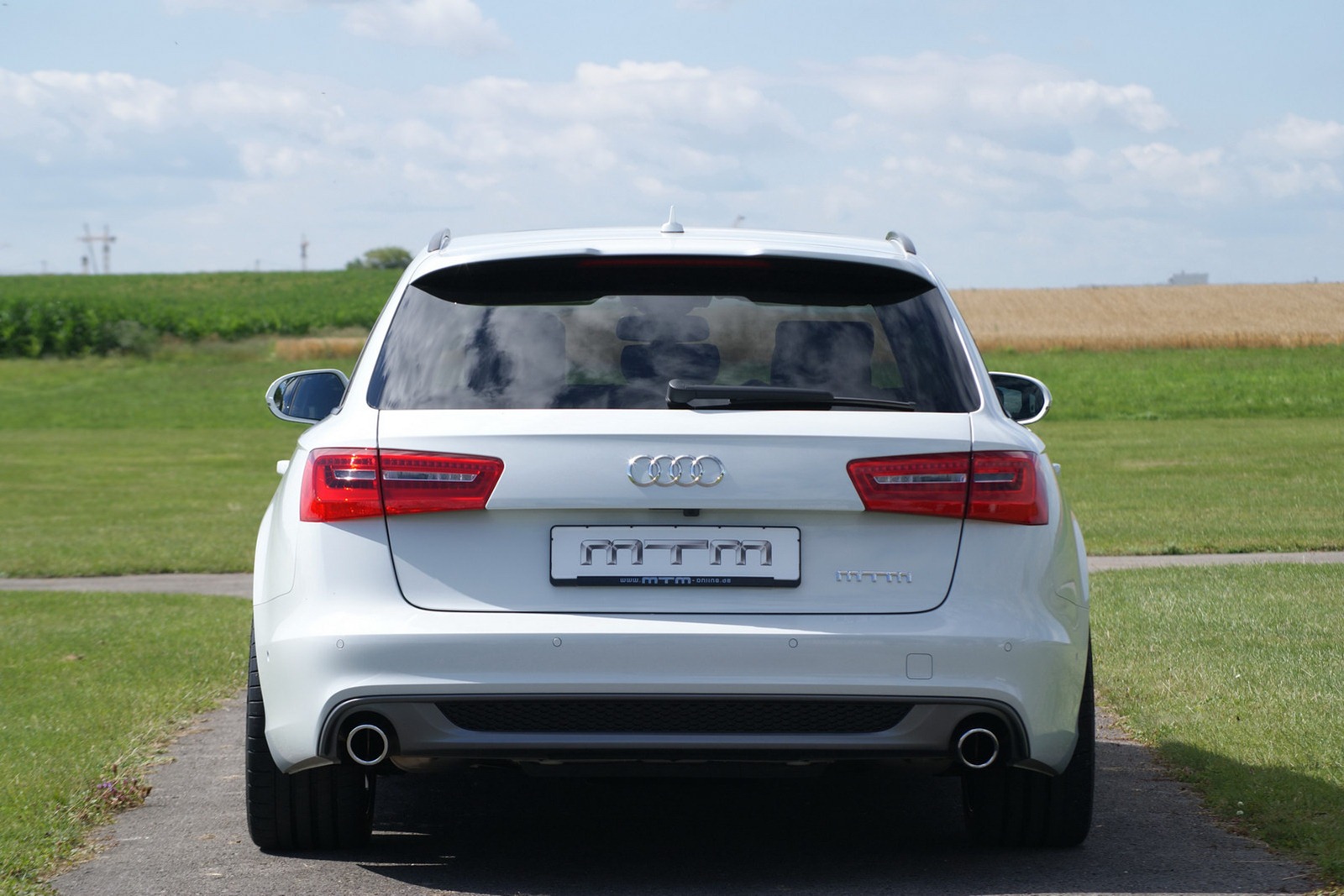
MTM Infuses Audi A6 3.0 BiTD with 376-Horses


Not that the Audi A6 3.0 BiTD in either Avant or sedan trims lacks the oomph, but if you're in need of more power and improved handling, then you may want to look at what Germany's MTM has prepared for the Four Ring brand's executive model. 

The fine-tuning starts from the engine bay where MTM engineers upgrade the V6 unit's software boosting output and peak torque from 309hp (313PS) and 650Nm (479 lb-ft) to 376hp (381PS) and 780Nm (575 lb-ft) respectively. 

The cost for the ECU optimization is set at €1,800 (US$2,230) while MTM also offers a slightly less powerful version at 360hp (365PS) and 760Nm (560 lb-ft) for €100 less. 


To improve the diesel-powered A6's stopping power, MTM has developed two different brake sets. The first one comes with 380 X 34 mm discs, stainless-steel-flex-line and eight-piston calipers priced at €4,900 (US$6,070), while the second set with uprated 405 X 36 mm discs at a cost of €6,400 (US$7,930). 

Next up on MTM's menu is the €1,740 (US$2,160) F-Cantronic ECU upgrade for the air suspension that allows the driver to drop the ride height by up to 25mm at the front axle and 20mm at the rear. 

Last but not least, the German tuner offers a variety of alloy wheel designs in sizes from 18- to 20 inches priced from €1,730 to €5,230 (US$2,140-US$6,480).  

Nagel Dakkar is the Dartz of all SUVs…and Then Some More


Dartz, the Latvia-based company that will be forever remembered for the Prombron Monaco Red Diamond Edition with its true- and then faux-whale penis leather dressed interior, has returned with an announcement for a new future product. 

The firm's new model is named Nagel Dakkar after Russian racing driver Andrew Nagel who the 1912 Monte Carlo Rally. 

Always up for a joke (we assume…), Dartz has this to say about the Nagel Dakkar: "This won't be just new car model - will be new class of cars we call it B.N.U.D.S."
And since you're surely wondering what B.N.U.D.S. stands for, we will allow Dartz's unedited press release to do the explaining:
Bespoke - as every car will be made specially for You
Noble - as this car will be sold under world one of the oldest car labels
Urban - as will be excellent for city ride - and doesn't matter narrows streets of Monaco, of wide highway in LA.
Desert - car will be bsed on tubular frame and designed by famous SAM - Saxon Automobile Manufactur which is wellknown with their rally car with all perfomance issues
Safety - using titanium tubular farme in new car will be achieved unseen before safety for "civil" cars."
The Latvian company released two different renderings of the Nagel Dakkar, a pencil sketch by its own Alex Isaev and a more professional looking CGI made by German designer Pochwatta. 

Dartz says the body and the interior of the SUV will be customizable while the underpinnings will remain the same and include a 650hp Mercedes-Benz AMG 5.5-liter bi-turbocharged V8 engine. 

Production will start in 2013 with prices for the base model ranging from €250,000 to €300,000 when it comes to Euro notes and $390,000 to $468,000 if you pay in good ol' US dollars – we have no idea why there's a difference between the two currencies. 

For more things that don't make much sense, hop over the break to read the rest of the press release from Dartz.

Story References: Dartz via Autoblog.nl
Dartz Press Release:
Attached - scetches from two car designers we are working with - DARTZ stuff designer Alex Isaev (pencil pictures) and German designer Pochwatta.
Our joint team now are in discussion how will look future, and - as we are bespoke car builders - may be it will have different bodies.
That's for sure, as our customers must have choise.
As all we know no ladie will come to party in same dress as other.
But, yes, they always come to this party in same cars.
yes, expensive, yes luxury - but - YES - similar.
DARTZ-SAM car will solve that issue, as on titanium frame we can put on "dress' or car body you want, you choose, you dream.
DARTZ-SAM will world one&only unique car which will mix highest quality of german engeneering and car building traditions with insane russian luxury.
DARTZ-SAM will be favorite car in Your garage - as when you will wake up don't knowing what's your plans for today, you can easy jump in in DARTZ-SAM - you can go off-road, all-road, or any-road.
DARTZ-SAM - car where you can make billions, like in business-pullman, and non-stop go to win rally.
WHY NOT? You work hard - You deserve it!
DARTZ-SAM plans is to get as minimum 1,3% of world luxury SUV market, but that's minimum, DARTZ already get request from Chinese government company which they signed contract at 2011.
As uniting of such out-of-box thinking teams look very promising.
Wealthy people need personalized cars and there are ten's of bespoke sportcars makers - but there are zero bespoke SUV makers.
That make people to buy regular SUV's and invest hundred's of thousands to upgrade them.
But anycase this are just regular cars, with expensive, but regular upgrade.

DARTZ-SAM sales plan on nearest years:2013 10 units
2014 20 units
2015 40 units
2016 40 units
2017 40 units

Car price is planned Eur 250,000 - 300,000 for base model.
$390,000-$468,000

car specifications:Engine
8 cylinder AMG Mercedes V8 Bi-turbo
Capacity 5.5L
Performance 650 HP, 850 Nm (626 lb ft)
Top speed 250 km/h
Drive train
Gearbox 7
gear double clutch gearbox
Clutch AP Racing
Sinter metallic Differentials Sadev
Body
Titanium tubular frame chassis Base for all the vehicles
Carbon Kevlar chassis Extremely light
Dimensions
Length 4620 mm (4-door / 4920mm)
Width 2000 mm Height 1700 mm (250 mm clearance)
Unloaded weight 1890 kgs / 1990 kgs
Wheel base 2910 mm (4-door / 3210mm) 

2014 BMW M3 Sedan Speculatively Rendered


We know that the next BMW M3 sedan is coming and we have a general idea of what it will look like thanks to an abundance of spy shots over the past year, but if you are still having a hard time visualizing the sportiest model in the F30 3-Series range, photoshop artist Wildspeed has put together these renderings. 

The CGIs (Computer Generated Imagery) propose a wider body with bloated front and rear wheel arches housing larger wheels in beefier tires, a vented hood, double-slat grilles, side skirts and a typical M-style front bumper with enlarged air inlets. 


What do you don't see here is the rear end of the car that will sport a redesigned bumper with a diffuser flanked by twin tailpipes on either side and possibly a boot lid spoiler. 

The F30 M3 sedan (along with the coupe model) will mark a return to a straight-six engine, but this time it will be turbocharged with an output of around 450-horses, up from the current unforced-induction V8's 414hp (420PS). 

A six-speed manual gearbox or an optional seven-speed dual clutch transmission will power the rear wheels.
We expect that the new M3 will be lighter than the current generation, possibly losing as much as 100kg (220 pounds) with significant benefits in handling, performance as well as fuel economy and greenhouse emissions.   

Ford Taurus 2.0L EcoBoost 2013 First Drive


Big car, small engine. The pairing may seem paradoxical, but Ford has made a habit of dropping its turbocharged, direct-injection 2.0-liter four-cylinder into its larger vehicles. The latest blue-oval big’un to get a small EcoBoost is the beefy Taurus; this additional engine option, joining a naturally aspirated V-6 and the SHO’s EcoBoost V-6, appears as part of the sedan’s 2013 refresh. As for its other big/small combos, Ford already has ladled the 2.0-liter into the Explorer and the Edge with mixed results. 

Pay More for Less
We’ve found that Ford’s 240-hp EcoBoost four does an admirable job of motivating the Edge and redesigned-for-2013 Escape crossovers, but is overburdened in the Explorer. The engine is the 2013 Fusion’s top-of-the-line motivator, and a higher-output version powers the new Focus ST. Regardless of which hood the 2.0-liter lives under, the engine is well-mannered and smooth, with linear power delivery and little turbo lag. 


The turbo four is paired exclusively with a six-speed automatic driving the front wheels and is available in any Taurus trim except the sporty, range-topping SHO model. As with the Edge and Explorer, the 2.0-liter EcoBoost four in the Taurus is a step-up, extra-cost engine. The promised return for its $995 price is improved fuel economy relative to the base V-6 engine—both the city and highway EPA ratings are three better here, landing at 22/32 mpg. In our experience, it’s tougher to get close to EPA mileage estimates in turbocharged cars, so we’ll reserve final judgment until we can fully test this model. 

Beefy Tostadas Can Accelerate, Too
Of all the big Fords to get the 2.0-liter EcoBoost four, we think the 2013 Taurus may be the most appropriate. It’s mostly a question of mass. The Taurus weighs a little less than an Edge when both are equipped with the engine. A 2.0-liter Explorer, on the other hand, weighs a good quarter-ton more than an Edge so equipped, tapping out the powertrain. Although down 48 hp on the Taurus’s base 3.5-liter V-6, the turbo four produces 16 additional lb-ft of torque, and its twist is available at a lower rpm. As a result, the 2.0-liter Taurus gets up and goes much like the front-wheel-drive V-6 sedan. The only indication that two cylinders are missing comes in the form of a faint resonance that enters the cabin at low revs in higher gears.
As befits its fuel-sipping mission, the four-cylinder Taurus’s six-speed automatic transmission dutifully grabs the highest possible gear as quickly as it can. There is a “sport” transmission mode, which delays upshifts until the tach needle swings closer to redline, but it seems uncouth to drive a non-SHO Taurus this way. A fidgety shift-lever-mounted rocker switch allows drivers to summon an up- or downshift at their leisure. Unfortunately, no matter how furiously you twiddle this switch, the transmission takes a good two-count to execute on the command. 


Dynamically, the four-pot car feels nearly the same as any other Taurus. Ford says the 2.0-liter-equipped version is roughly 55 pounds lighter than a comparable V-6 model; four-cylinder cars get slightly different front spring rates along with minor changes to the dampers to account for the lighter load. You don’t feel the weight difference, and the thing still feels heavy because it is. At least the squishy suspension isolates passengers from all but the worst road imperfections. The electrically assisted steering is devoid of road feel, weighting up only off-center. An added bonus for all 2013 Taurus models is an upgraded brake master cylinder, which has firmed up pedal feel and reduced its travel.  

VEHICLE TYPE: front-engine, front-wheel-drive, 5-passenger, 4-door sedan
BASE PRICE: $28,390
ENGINE TYPE: turbocharged and intercooled DOHC 16-valve inline-4, aluminum block and head, direct fuel injection
Displacement: 122 cu in, 1999 cc
Power: 240 hp @ 5500 rpm
Torque: 270 lb-ft @ 3000 rpm
TRANSMISSION: 6-speed automatic with manual shifting mode
DIMENSIONS:
Wheelbase: 112.9 in
Length: 202.9 in
Width: 76.2 in Height: 60.7 in
Curb weight (C/D est): 4100 lb
PERFORMANCE (C/D EST):
Zero to 60 mph: 7.0 sec
Standing ¼-mile: 15.4 sec
Top speed: 112 mph
FUEL ECONOMY:
EPA city/highway driving: 22/32 mpg

Sunday, August 5, 2012

2013 Chevrolet Camaro SS 1LE: 1 Less Excuse to Not Buy a Camaro


There are some things about the ’80s that aren’t worthy of nostalgia. The era’s pony cars, by and large, fall under this umbrella. It’s true that Ford has the five-point-oh—a designation fairly soaked in Aqua Net, yet perhaps the only thing about the decade’s Stangs worth revisiting—but when it named its latest track-oriented model, it resurrected “Boss”. First appearing in 1969, Boss is cool, it’s a little intimidating, and it’s also Bruce Springsteen’s nickname. It sounds bad-ass. Chevrolet’s 1LE? For the 17 people who were paying attention in 1988, it conjures memories of an option bundle that only made that year’s Camaro less bad. To the rest of us, it sounds like three randomly selected characters. 


While it still seems as though the designation was plucked from an alphanumeric bingo bucket, 1LE has new significance for 2013 as an option package for manual-transmission Camaro SS models. It brings a host of upgrades either ported from or inspired by the mighty ZL1. The pieces that make the most difference fall into the latter category, however, including the front anti-roll-bar mounting setup, 10x20-inch front wheels and 11x20-inch rears, and beefier half-shafts. The gear pilfered directly from the ZL1 includes wheel bearings, toe links, rear shock mounts, the fuel pump, the flat-bottom steering wheel, the short-throw six-speed manual and its transmission cooler, and 285/35-20 Goodyear Eagle Supercar G: 2 tires all around (the ZL1 gets 305/35-20 rubber at the rear). The beefy wheel/tire combo actually saves a total of 22 pounds of unsprung weight. 

The 1LE package also comes with a shorter final-drive ratio of 3.91:1 versus the 3.45:1 rear end in the SS, and adds monotube rear dampers—instead of the SS’s twin-tubes—and a strut-tower brace. As for externals, Chevy engineers tell us that while the 1LE’s splitter increases downforce in the front, the wider wheels generate enough lift to bring the 1LE right back in line with the SS. Out back, the SS’s lip spoiler carries over to 1LE cars.


VEHICLE TYPE: front-engine, rear-wheel-drive, 4-passenger, 2-door coupe
BASE PRICE: $37,305
ENGINE TYPE: pushrod 16-valve V-8, aluminum block and heads, port fuel injection
Displacement: 376 cu in, 6162 cc
Power: 426 hp @ 5900 rpm
Torque: 420 lb-ft @ 4600 rpm
TRANSMISSION: 6-speed manual
DIMENSIONS:
Wheelbase: 112.3 in
Length: 190.4 in
Width: 75.5 in Height: 54.2 in
Curb weight (C/D est): 3900 lb
PERFORMANCE (C/D EST):
Zero to 60 mph: 4.6 sec
Zero to 100 mph: 10.5 sec
Standing 1/4-mile: 13.0 sec
Top speed: 157 mph
FUEL ECONOMY:
EPA city/highway driving: 16/24 mpg

2013 C-Max Hybrid to Start at $25,995


Ford has priced the C-Max Energi plug-in hybrid at $33,745, slightly higher than the least-expensive Toyota Prius plug-in. The C-Max is eligible for a $3750 federal tax credit, which brings its overall cost just below the $30,000 mark. Three option packages are available for between $1195 and $2495, and include goodies like navigation and a Sony audio system, a power liftgate and a backup camera, and active parking assist. The Energi plug-in’s electric-only range is 20 miles, or about half of Chevy’s 38-mile claim for the Volt, which costs $32,495 after a federal tax break of up to $7500. To the Ford’s credit, you get more space for your stuff and a fifth seat.

It has been a while since we last heard any news regarding Ford’s upcoming C-Max twins—hybrid and plug-in Energi—but today the silence was broken. Ford has announced the C-Max hybrid will start at $25,995 when it goes on sale in the fall. (The company has not disclosed how much it will charge to deliver the C-Max to a dealer near you.) Ford is quick to point out that the C-Max’s price undercuts that of Toyota’s similarly sized Prius V tall hatchback/small van thing by $550. (Again, not including applicable destination charges.) The C-Max Energi plug-in hybrid will arrive towards the end of 2012 and its price tag hasn’t been revealed.

As you can probably tell, Ford is sizing up Toyota’s Prius V as the C-Max hybrid’s key competitor, with the V and the plug-in version of the regular Prius falling into the C-Max Energi’s sights. Ford also took the opportunity to hype the C-Max hybrid’s Toyota Prius V–beating efficiency, although the company did not provide any numbers for comparison; the Prius V is EPA rated for 44 mpg in the city and 40 mpg on the highway. Ford claims that the C-Max Energi will better the Prius plug-in’s 95 MPGe electric-mode fuel economy, as well as that car’s total driving range.

The C-Max hybrid will go on sale nationwide this fall, but the C-Max Energi will initially be available only in select markets. Ford will ship the Energi only to its electric vehicle–certified dealers—the same ones trained up on the Focus Electric. That means the same 19 markets where the Focus Electric is currently available will also get the C-Max Energi. The Energi’s limited distribution pattern makes sense, as it’s built on the same line as the Focus Electric. Expect more details on both C-Maxes in the coming months. Tags:  | 

You will be redirected to the script in

seconds