www.Lookscar.blogspot.com

The Volkswagen Jetta’s long-awaited changeover from the current inline-five-cylinder engine to a turbo four will happen in 2013 for the 2014 model year, the company’s U.S. product czar Rainer Michel told us this week. Soon after, Michel says, the engine will land in a 2014.5 model-year Passat. This confirms the timing we heard earlier from a different—and has-to-stay-nameless—source.

www.Lookscar.blogspot.com

The BMW 328i Luxury's logbook had finally cooled down after a disappointing trip to the local road course when something else happened: the weather heated up. Between surviving one choice mishap and dealing with sweltering temperatures, our BMW has had a rough month.

www.Lookscar.blogspot.com

Vorsteiner has created a new aero package for the already gorgeous 458. This includes a front spoiler, side skirts and a revised rear diffuser. This is combined with specialised 21 inch rims. All parts are made out of carbon fibre.

www.Lookscar.blogspot.com

Spanish specialty carmaker Aspid Cars has dropped the primary teaser pictures of its new GT-21 Invictus, a 2+2 seater sports automotive. this is often Aspid's second vehicle series when the hardcore Super Sports (SS), which sort of resembles a Lotus seven on steroids.

www.Lookscar.blogspot.com

The version of the ATS that Cadillac meant to spice up the company’s overall fuel-economy numbers has simply received a rather lackluster rating from the EPA. With a Two hundred-hp, 2.5-liter four-cylinder engine, the ATS is rated at simply twenty two town mpg and thirty three highway.

Thursday, July 12, 2012

Hyundai i30 Wagon


Hyundai has showed off photos of its new i30 Wagon that will make its world debut at the Geneva Motor Show next month. The all-new wagon will join the i30 hatchback in Hyundai's European lineup later this year. 

We know the i30 hatchback here in the States as the all-new 2013 Hyundai Elantra GT, which made its debut earlier this month alongside the two-door Hyundai Elantra Coupe at the Chicago Auto Show. American buyers also get a third, sedan version of the Elantra, as well. The new i30 Wagon is powered by the same engines as the Euro i30 Hatchback, including three gas and three diesel engines, ranging from 89 to 133 hp. Overall length of the wagon is up 7.3 inches to 176.6 inches compared the hatchback, and cargo room behind the rear seats has grown to 18.6 cubic feet; with the rear seats folded cargo space is more than tripled to nearly 58 cubic feet. 
 
 
Hyundai's i30 Wagon was designed alongside the i30 hatchback at Hyundai's R&D center in Ruesselsheim, Germany, "enabling the stylists to fashion a coherent design that bears a strong family resemblance inspired by Hyundai's fluidic sculpture form language," according to Hyundai. The i30 hatchback and wagon are nearly identical on the front, but from the B-pillar back the wagon's roofline extends further back giving it a proper station wagon look while retaining Hyundai's family resemblance. 
 
 
The rear window wraps around the D-pillar to decrease blind spots. The i30 Wagon will be the second bodystyle of the i30 line sold in Europe, and Hyundai has no plans to bring it across the pond. Should Hyundai bring a proper Elantra Wagon stateside, for a full lineup of C-segment cars? Or does the upcoming GT model fill the bill for a practical, yet sporty five-door? Share your thoughts in the comments below.  


Kia Cee'd Hatchback


The first-generation Kia Cee'd ushered in a new design language for Kia in Europe, and it looks as if history is about to repeat itself. The next-generation Cee'd, which is slated to debut at the 2012 Geneva Motor Show in March, appears to push the design envelope even further.

The latest Cee'd - which is likely to remain a European exclusive - remains a hatchback, but shares only its daylight opening shape with its forebear. The new Cee'd packs plenty of Kia's latest design DNA into a compact vehicle: the corporate "tiger nose" grille is more prominent than ever, and flanked by long, tapered headlamps and a dramatically flared hood. As usual, the car also receives LED running lamps placed along the lower edges of the headlamp housings.


Further back, the new Cee'd shares a number of cues with the smaller Rio: taillights are mounted high up the curvaceous rear end, although the bumper cut echoes the shape of the hatch stamping itself. The lower diffuser is also a little more sophisticated, with raised accents surrounding the rear reflectors, license plate, and lower diffuser.


Inside, the interior is anything but drab. Like the Optima, the Cee'd's instrument panel wraps into the center stack. Grey plastic materials used on the dashboard itself are broken up with strips of glossy piano black trim. Door panels are two-toned, and the leather seats shown here feature contrast stitching. The look is refreshingly high-end - which is welcome, considering the C-segment continues to move upmarket in around the globe.

As for the mechanicals, it's still anyone's guess: Kia has been tight-lipped about the car's selection of engines. Currently, European models feature a range of gasoline and diesel engines that make anywhere between 89 and 126 horsepower, but it's been rumored that the Procee'd, the three-door version of the Cee'd, could make use of the the same 1.6-liter turbocharged four-cylinder engine used in the new Hyundai Veloster Turbo.


Also unknown at the moment is whether or not this car will make it to the United States. We wouldn't be surprised if it didn't: after all, the previous Cee'd was designed expressly for the European market, which left North America with the Forte. We may not see a Cee'd on our shores, but we can only hope the next Kia C-segment offering for North America looks this good.  

Toyota NS4 Plug-In Hybrid


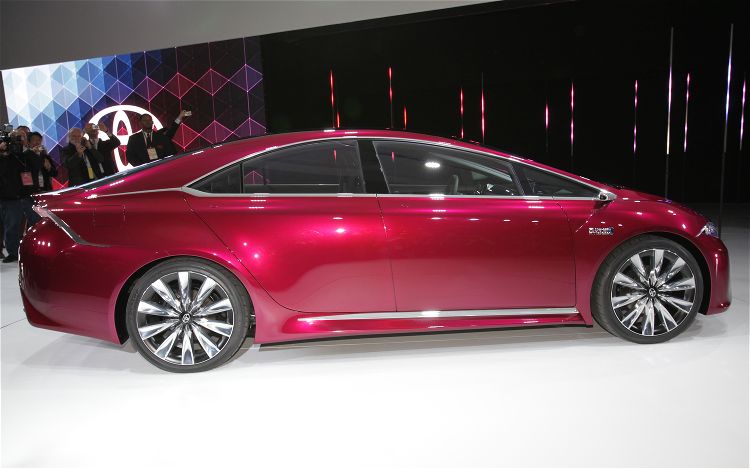
Toyota unveiled the NS4 plug-in hybrid at the 2012 North American Auto Show. Toyota is using the NS4 to demonstrate future safety features, connectivity technology, efficient drivetrain, and design ideas. Many members of the crowd were expecting to see another variation on the Prius theme and were surprised to see one of Toyota’s most interesting designs. 

 
Powered by the next-generation of Toyota’s Hybrid Synergy Drive, the NS4 is NOT envisioned as a halo vehicle at the top of the Prius sub-brand, but rather is meant to indicate that as public interest in alternative powertrain vehicles increases, HSD will be extended to more non-Prius vehicles. As for that “next generation” HSD, it features smaller and lighter components, improved overall fuel economy, better acceleration, longer all-electric range, and a short charge time, but does NOT adapt a Volt-style drive system that enables the internal combustion engine to turn the wheels directly for improved efficiency and permits full-range speed and acceleration in electric mode. 
 
 
Connectivity is said to be elevated to a new level in the NS4 with a user-interface that includes a multi-touch screen that looks and feels like a smartphone. We’re assured that it will be simple and intuitive to operate, conveying information quickly without distraction while maximizing driver awareness (didn’t Ford say that about SYNC?). This system is supposedly capable of “learning” driver preferences and habits to anticipate driver responses in certain situations. Other interesting features of the liftback sedan include doors that swing up and out to clear high curbs (like an Aston Martin Rapide’s), and new hydrophobic glass (naturally sheds water and fog) that manages to reduce glare and ultraviolet light transmission without blocking radio waves (did you know that earlier anti-UV glass made some cars shield the signal from criminal-tracing ankle-bracelets?). 
 
 
On the safety front, there’s a suite of collision-avoidance systems that use millimeter-wave radar and stereo-vision cameras to predict and avoid lane-departure, rear-end, and pedestrian collisions. The headlights are fully adaptive to provide high-beam illumination while preventing glare when other cars or pedestrians are present. For now, the NS4 is purely a concept car and we find all of the tech goodies reasonably interesting, but what we REALLY hope is that cars like the Camry get a bit of this styling love by 2015–or earlier  . 
 

Sunday, July 8, 2012

Mazda Officially Reveals Mildly Facelifted 2013 MX-5 Roadster in Japan


A leaked brochure gave us our first look at the mildly refreshed MX-5 in both soft- and retractable hard-top (RHT) body styles earlier this week and now Mazda has come out with an official release for the 2013 model that goes on sale today in Japan. 

We suspect that if not all, most of the changes on the JDM model will be applied on the international market versions before the end of the year. 


The second facelift for the third-generation MX-5 since its debut in 2005 brings a redesigned face with a new bumper sporting a larger front grille opening with a more curved upper part, new front fog lamp housings, a front chin spoiler plus black headlamp bezels for the soft-top and chrome bezels for the hard-top model. 


In addition, the refreshed roadster model gains a pedestrian protection system in the guise of an Active Bonnet, which raises the rear end of the hood in the event of an accident to absorb the energy of impact and reduce the severity of head injuries in collisions involving pedestrians. 


Also new for the 2013 model year is the Dolphin Gray Mica paint finish that replaces the Metropolitan Gray Mica and newly styled 17-inch alloy wheels for the MX-5 RHT. 

Inside, the Japanese carmaker has introduced a new tan color option for models fitted with leather seats while a Glossy Dark Gray finish is used for the decoration panel and steering wheel bezel. 


Finally, Mazda's engineers have tweaked the throttle and brake booster to improve control of the accelerator in the manual transmission models and the brakes in all models. 


In Japan, the updated MX-5 starts at 2,330,000 Yen (about US$29,200 / €23,300


Saturday, July 7, 2012

Next BMW X1


When the next generation BMW X1 arrives sometime around 2015, it will be based on a front-wheel drive architecture, sharing its platform with the Mini Countryman. This isn't new news – stories and editorials have been parsing BMW's FWD strategy for more than a year, and in April of 2011, now-CEO Ian Robertson proclaimed there could be six to nine new BMW and Mini models as part of a "compact car family" based on a shared platform. 


A report in Autocar about the switch adds a few more details, though. In addition to the cost benefits from this arrangement, the next X1 will lose its six-cylinder engines but offer more room. The tranverse-mounted engines preclude the six-pot unless BMW redesigns it, so plans are for nothing any larger than four cylinders and possibly the 1.5-liter, three-cylinder powerplant slated for the 1 Series GT. A Haldex clutch will continue to provide AWD capability, and the upshot with the smaller engine bay and firewall moved forward is more room for passengers and cargo.


The platform is referred to as "UKL," for Unter Klasse (Under Class), and its place in the product portfolio is apparently more complex than simply saying it will form the basis for small Mini and BMW models: stories suggest it has been built with the flexibility to underpin the next generation 1 Series as well as the next generation 3 Series. No, that does not mean the advent of a front-wheel drive 3 Series, since the UKL platform was reportedly designed with features like a movable firewall support enabling transverse and longitudinal engines as well as FWD, AWD and RWD powertrains. It does, however, mean the ads proclaiming "This is why we don't make front-wheel drive cars" will probably never surface again. 


Artist Imagines Sporty Range Rover Evoque R with Supercharged V6


A string of unsubstantiated rumors concerning Land Rover's intent to develop a high-performance version of the Range Rover Evoque provided the inspiration for a digital mockup of what such a model could look like from the crew over at PS-Garage. 

The so-called Range Rover Evoque R was envisioned as a three-door model powered by the Jaguar-Land Rover group's newly announced 3.0-liter supercharged V6 delivering up to 375hp (380PS) and 460Nm (339 lb-ft) in the upcoming Jaguar F-Type roadster. 

On the styling front, the three-door version of the Evoque was given a more vigorous look with flared wheel arches trimmed in black that house larger alloy wheels, rocker panels, more prominent air vents, tweaked bumper and grille designs plus a lowered ride height. 

McLaren MP4-12C Spider Has Arrived.

Ladies and gentlemen it has arrived the fastest convertible this side of the Bugatti Veyron Grand Sport. With the same revolutionary suspension and brutal 3.8l V8 pumping out 460kw it’s a recipe for great motoring. Most Journo’s have been left cold by the hard top but, the roof-less alternative will change some opinions and with Jenson Button giving it the thumbs up. The soft top is of the metal folding kind and the Spider makes the hardtop look like a bland piece of cheese.  McLaren dealers are taking orders now that is if you can afford it.

View the original article here

Friday, July 6, 2012

Mazda to Increase CX-5


The new CX-5 is proving to be a bright spot for Mazda, which has announced plans to increase production capacity of the compact crossover by 20 percent, from 200,000 to 240,000 units per year. This will be achieved by expanding production from Mazda's Ujina Plant No.2 in Japan to also include Ujina Plant No.1.
The news follows a previous announcement from the automaker that it would expand production of the CX-5 from 160,000 units to 200,000 units. 

The Japanese brand said that since sales began in February this year, demand has far surpassed initial estimations and that it has upgraded its annual global sales target from 160,000 to 190,000 units for the fiscal year that ends on March 31, 2013. 


According to the company, as of July 1, it has received 24,000 orders in Japan, more than doubling the annual domestic sales target in less than five months from the beginning of sales, while in Russia, there are more than 10,000 orders compared to an annual sales target of 12,000 units. In the States, Mazda has sold a little over 16,000 CX-5s from the end of February through June. 

In related news, Mazda announced it will be doubling production capacity of its SKYACTIV-D diesel and SKYACTIV-G gasoline engines, which are offered on several models including the CX-5 and Mazda3 (only the petrol unit), from 400,000 units to 800,000 units per year in October 2012. 

Both types of engines will be offered on the brand-new Mazda6 coming next year. 


Mazda is targeting annual sales of 1,700,000 vehicles globally in the fiscal year ending March 2016, with 80 percent of these cars to employ SKYACTIV TECHNOLOGY. 

Gimmick Cars

It has been getting more and more under my skin as time has gone on, with motoring manufactures producing cars with no purpose or reason other than to fill a gimmick market for people with too much money or too little sense.

These worthless monstrosities haunt the roads in all their overpriced “facebooked” up hype. They serve no purpose; no segment of the market no ingenuity. They are there simply to exploit the person with money and no sense, the person that likes to buy clothing from a certain brand that puts rhinestones and big gaudy tigers on their clothing. So I will have to pick on two cars to make my point, two cars that have been bugging me since their first inception and every time I see some dim-witted person driving them around. Drum rolls are not needed here more like a firing squad, for the Polo Cross and the Toyota Prius.


So let start with the Cross, so just when you thought that the Polo range was too small and limited VW bring on the Cross, an off-roading Polo. So when you think of and off road car you think rugged and tough with plenty of ground clearance and 4WD. Not a Polo with slightly raised suspension, and some plastic bits covering the bottom half of the body work. Not to mention the on-off road 17” low profiles that makes it that much easier to hit the beaten track and absorb those rocks and ditches. And when you think off road you know, just know it must come with a 4WD system of some sorts like the Suzuki Jimmy that cost considerably less… Well no, the standard gearbox is good enough with front wheel drive to boot, once again just what you need when you hit the muddy hills and snowy roads. Okay I know I am going on a bit but, when a Standard Polo 1.6 costs around R20, 000 less and is just as capable off-road as the Cross and probably more suited to doing the dual role you have to ask yourself what’s going on. The reason I think they called it the Cross is because that’s what you’ll be when the light bulb finally turns on.


Now for the Toyota Prius, an eco friendly car for people that want to save the world one litre of fuel at a time. Well no not really let’s be honest it is shockingly ugly, like the designers got bored at the roof and gave up. Yes, I know it’s to help aerodynamics but a Ferrari 458 Italia is aerodynamic and doesn’t look like aerodynamically shaped loaf of bread. The goal of the car is to save fuel with its hybrid drive but, it doesn’t. You’ll never ever hit the Toyota’s claims, well unless you drive everywhere at 20km/h downhill. You would be much better off buying a Euro hatch with tiny a turbo petrol and much better looks. But I suppose then you will not get the adoring looks from the tree hugging ladies out there. In my mind the only hybrid that should be allowed on this planet is the Jaguar C-X75 which uses jet turbines to power electric motors and the Audi R18 e-tron Quattro Le Mans car. These serve a purpose push the limits and progress us as humans, the latter only seems to show how dumb we still can be and how easily we are convinced. This all knowing  that your are destroying the environment even faster by buying this “eco-friendly” nonsense


So to sum up you have to really, really know nothing about cars at all to spend your hard earned cash on these gimmick cars. And I know that these aren’t the only ones out there, I just chose to pick on these two because, I see so many of them out there. They are cars that serve no purpose other than to rob you of your hard earned money and make you seem extremely gullible. You have to completely believe the brochure and everything the salesman tells you. While ignoring facts, research and commonsense walk right past everything else (which there is a lot of) and go for a “Gimmick Car”. I know there are going to be people throwing toys out of their cot that I insulted their car that they have spent their hard earned money on. Well “Mr Eco Smug” and “Ms Urban off-roader” if you are going to do the crime then be prepared for the hail of sniggers and pointing fingers, as passers-by stair at you. And I don’t mean stare like ooooooh there goes a Lamborghini but, the other kind like you’re back at school and you have a piece of toilet paper sticking out of your pants… You have been Warned even though I know that no one will take a blind bit of notice of this and  these will still continue to fly out of the showrooms and clog up our roads.


New Jaguar XJ_e Plug-in Hybrid


Jaguar chose the Goodwood Festival of Speed that runs from June 28 to July 1 for the world premiere of a new technology study based on the XJ limousine. 

The new XJ_e was created to exhibit Jaguar-Land Rover's (JLR) capabilities and future plans as in theory, the concept's plug-in hybrid drivetrain can be used in most of the group's models. The study follows other hybrid research demonstrators from JLR including the Limo Green and Range_e vehicles. 

Before we dive into more details, we should note that the XJ_e project was part funded by the UK Government’s Technology Strategy Board through the REEVolution project, and engineered in partnership with several UK technology companies "to help develop expertise for ultra-low carbon vehicles within the supply chain". 

The XJ_e is fitted with a parallel, plug-in hybrid electric vehicle (PHEV) system, which combines the JLR's 2.0-litre turbocharged direct-injection petrol engine with a hybridised 8-speed automatic transmission for a combined output of 329hp (334PS). 

The hybrid system makes use of a 69kW motor/generator and a 12.8kWh Lithium Ion battery pack, which can be fully charged by a 240V domestic supply in about four hours. 


Jaguar says the XJ_e can run on pure electricity for up to 40km (25miles), on gasoline power alone, or a combination of both. 

The plug-in hybrid version of the XJ is capable of completing the 0-100km/h (62mph) sprint in under 6.5 seconds and has a limited top speed of 250km/h (150mph). 

According to the British company, the XJ_e achieves CO2 emissions of "less than 75g/km" and an average fuel consumption of 3.2lt/100km (88.3mpg UK or 73.4mpg US). 


The XJ_e will be displayed in the FoS-TECH Technology Pavilion at Goodwood over the weekend.  

You will be redirected to the script in

seconds